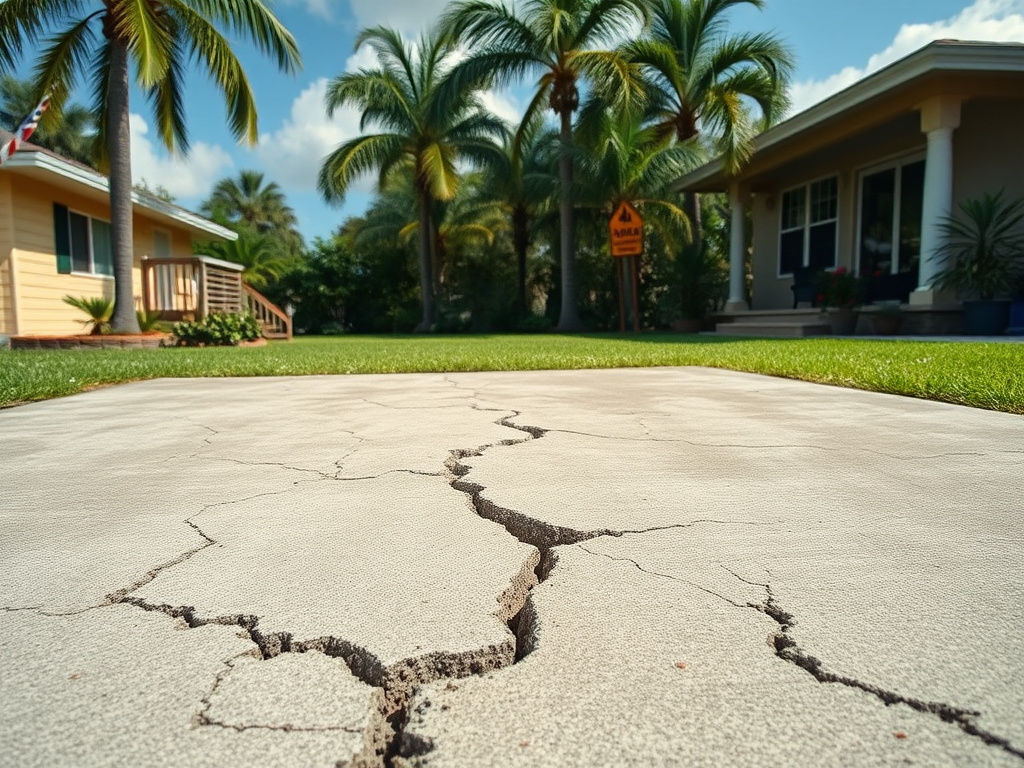
Sinkhole & Settlement Repair
Sinkhole & Settlement Concrete Repair for Florida Homes
Honest diagnosis first, then the right physical fix — structural fill and polyurethane injection for a confirmed void, straightforward lifting for ordinary settlement.
Florida Geology
Understanding Florida's Karst Geology
Much of Florida sits on porous limestone and dolomite bedrock. Groundwater moving through that rock is naturally slightly acidic, and over time it slowly dissolves the stone, hollowing out underground voids. Eventually the soil above one of those voids loses its support and gives way — sometimes gradually, sometimes all at once — and whatever concrete or structure sits on top follows it down.
That's the mechanism behind what's commonly called “Sinkhole Alley”: a west-central corridor running roughly from Tampa Bay to Ocala. Pasco County has the highest per-capita sinkhole rate in the country, and Hernando, Hillsborough, Polk, Marion and Alachua counties see the next-heaviest activity in the state.
Southeast Florida — Miami-Dade, Broward, Palm Beach — is a different story geologically. Sinkhole activity there is comparatively low, but soft fill soils and a high water table drive plenty of slab settlement on their own, and coastal and hurricane exposure adds to it. Wherever you are in the state, a sinking or cracking slab has a physical cause worth diagnosing properly.
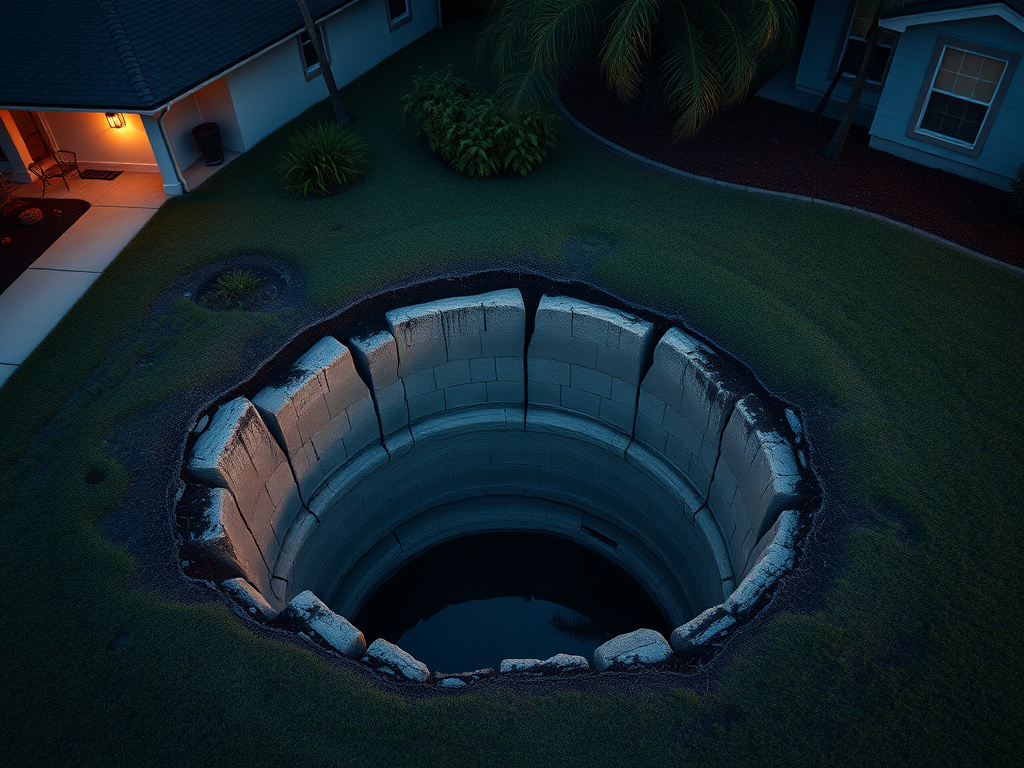
Not every void under a Florida slab is dramatic. Geologists generally describe three patterns: slow dissolution that gradually lowers the ground over years, gradual sand settlement as material filters down into a shrinking cavity below, and — far less common but the one people picture — a sudden collapse where soil above a cavern gives way all at once. Almost everything we're called out for falls into the first two categories, which is exactly why an inspection matters more than assumptions.
Warning Signs
Warning Signs You Shouldn't Ignore
None of these signs on their own prove a sinkhole is forming — most turn out to be ordinary settlement. But every one of them is worth a physical inspection rather than a guess.
- ✓Cracked slabs, especially stair-step cracking through block or stucco
- ✓Doors and windows that stick, bind, or no longer latch properly
- ✓A widening gap between the slab and the foundation wall
- ✓New depressions or soft spots forming in the yard
- ✓Fence lines, pavers, or walkways shifting out of alignment
- ✓Areas that pool or drain differently after rain than they used to
The Inspection
How We Tell Settlement, an Active Sinkhole, and a Foundation Issue Apart
An inspection starts with elevation readings across the slab, mapped against a level reference, followed by a close look at how any cracking runs. Isolated, stable cracking near a single sunken corner usually points to ordinary soil settlement. Cracking that radiates outward, keeps changing month to month, or pairs with a growing gap at the foundation wall points toward an active void underneath.
We probe suspected soft areas to get a sense of depth and extent before recommending a repair path. If what we find looks like it involves the house's foundation walls or structural framing rather than the slab in front of it, that's outside the scope of concrete repair — we'll tell you plainly and point you toward the right kind of professional.
We also factor in history. A slab that has settled once before, been repaired, and is now moving again gets treated differently than a first-time sunken corner — repeated movement in the same spot is one of the stronger indicators that there's an underlying void rather than a one-time compaction issue, and it changes how thoroughly we probe before recommending a fix.
The Repair
Structural Fill and Polyurethane Injection: The Repair Sequence
Once a void is confirmed, the sequence matters. Lifting a slab with foam alone over an open cavity just bridges the gap instead of fixing it — the slab needs solid support underneath before it's raised. That's the whole reason structural fill comes first: it converts an open cavity into a stable base, so the polyurethane that follows is lifting the slab onto solid ground rather than floating it over empty space.
Confirm & Map
Elevation readings, crack mapping, and probing confirm the void's rough size and depth.
Structural Fill
For a confirmed open void, a structural grout fills the cavity so the slab has solid support to rest on.
Polyurethane Injection
Polyurethane foam is injected to lift the slab and densify the surrounding soil.
Verify Stabilization
Follow-up readings confirm the slab is holding level before we move to surface work.
Surface Repair
Injection points are patched, joints are sealed, and the finish is restored to match.
Honest Limits
When We Bring in Geotechnical and Engineering Partners
Concrete repair has real limits, and we're upfront about them. A void that's unusually large, unusually deep, or paired with visible movement in the house itself — cracked foundation walls, doors that have shifted out of their frames, structural framing that's no longer square — calls for soil borings, ground-penetrating radar, or a licensed structural engineer's review before any concrete work proceeds.
In those cases, we coordinate scope with the outside professional rather than working around them. It's slower, and it's the right way to handle a problem that goes deeper than a slab.
We'd rather lose a same-day repair than lift a slab back onto ground that hasn't actually been stabilized. A physical fix that doesn't hold isn't a repair, it's a delay — and that's the standard we hold every diagnosis to, whether the news is simple or not.
Surface Finish
Repairing the Surface After Stabilization
Stabilizing what's underground is only half the job. Once the slab is holding level, we match its height back to the surrounding grade, patch and seal the injection points, and clean up any cosmetic cracking left over from the settlement. If the slab had an existing polyurea or epoxy finish that was damaged in the process, we recoat it so the surface looks and performs like nothing ever happened underneath it.
Cost Factors
What Affects the Cost of Sinkhole and Settlement Repair
These are typical Florida market ranges based on the physical scope of the work, not a quote for your property.
$1,700–$4,000
Typical whole-project range
$500+
Small single-slab jobs
$20,000+
Large commercial slabs
Free
On-site inspection
Depth and size of the void drive most of the cost — a shallow, contained area of settlement costs far less to correct than a deep void requiring a full load of structural fill. Access affects it too: a driveway a rig can reach easily is cheaper to repair than a site with tight equipment clearance. Whether structural fill is required before injection is usually the single biggest swing factor, along with how much surface finish work — patching, sealing, recoating — the repair calls for once the slab is stable.
Number of injection points matters as well. A single sunken panel might need a handful of holes to bring level; a slab that's settled across its full width needs a wider grid to lift evenly without introducing new stress cracks. We walk through all of this during the inspection so the number you receive is itemized by task, not a single unexplained figure.
Prevention
Reducing Future Settlement Risk
Most ordinary settlement traces back to water — either too much of it moving through the soil, or moving through it in the wrong place. Grading the yard so it slopes away from the slab, adding drainage swales in low spots, and extending gutter downspouts well past the foundation all reduce how much water erodes the soil under your concrete. Irrigation heads aimed directly at a slab edge are a surprisingly common culprit worth checking, too.
None of this prevents a genuine sinkhole void from forming in karst bedrock — that's a geological process, not a landscaping one — but it meaningfully reduces the ordinary settlement that accounts for most of the calls we get.
We also recommend a simple annual habit: after the first big storms of the wet season, walk the perimeter of any slab you've had repaired and look for new pooling, softening ground, or a downspout that's started dumping closer to the foundation than it used to. Catching a drainage problem early is far cheaper than catching it after it's eroded soil out from under the slab again.
What to Expect
Inspection to Repair: What the Timeline Looks Like
Every repair starts with a physical inspection and ends with a slab that's level and finished. Here's roughly how that plays out.
| Free on-site inspection | Scheduled within days statewide; often sooner in the west-central corridor. |
|---|---|
| Diagnosis & geotechnical referral, if needed | Same visit in most cases; 1–2 weeks if outside soil testing is warranted. |
| Structural fill + injection repair | Typically 1–2 days on site, depending on void size and access. |
| Surface repair & finish | Same day to next day after stabilization is verified. |
Where We Work
Statewide Service, Priority Response in the West-Central Corridor
We inspect and repair sinkhole-related and ordinary settlement damage statewide, from the Panhandle to the Keys corridor. Given how much of Florida's settlement activity concentrates in the west-central Sinkhole Alley counties — Pasco, Hernando, Hillsborough, Polk, Marion and Alachua — we prioritize scheduling there, while still traveling for jobs across the rest of the state.
See our full Florida service area breakdown for region-by-region response expectations, or read how we approach polyurethane concrete lifting for slabs that need leveling without a confirmed void, and how that compares to a full slab replacement.

Get a free sinkhole & settlement inspection
Tell us what's cracking, sinking or shifting. We'll come back with an honest diagnosis and a scoped, itemized repair number.