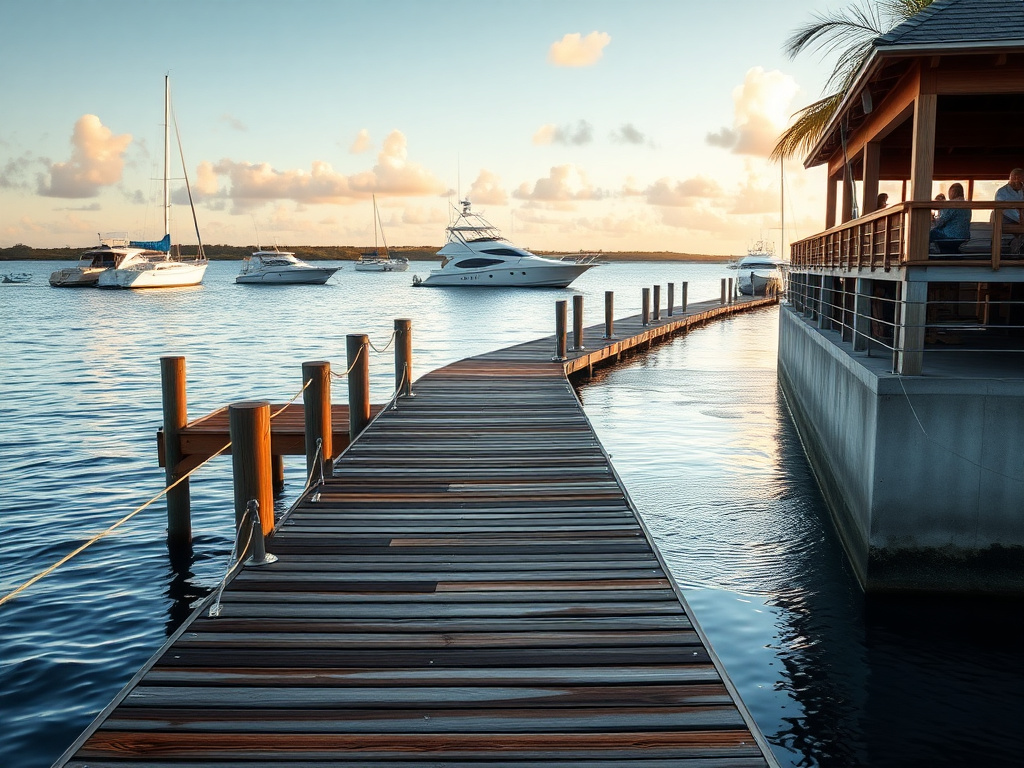
Waterfront Protection, Built for Salt and Tide
Marine, Dock & Seawall Polyurea Coatings for Florida Waterfront Property
Seawalls, dock decking and boat lift hardware take a beating no interior floor ever sees — saltwater splash, tidal cycling, UV and storm surge, all at once. A seamless polyurea membrane is built for that environment specifically.
Why waterfront surfaces fail first
Florida's waterline is the hardest environment on the property
Everything at the water's edge is working against whatever coating, sealer or paint was applied last. The splash zone gets alternating saltwater soaking and drying dozens of times a day as boat wakes and tide move past the same six inches of concrete or wood. That wet-dry cycling drives salt crystallization into pores and hairline cracks, which is exactly how spalling concrete and corroding rebar get started on a seawall cap that looked fine a year earlier.
Add full Florida sun with no shade structure over most docks, and UV breaks down standard sealers and marine paints faster than it would on a shaded interior surface. Wood decking checks and grays. And anywhere the structure sits below the waterline or in the intertidal band, marine growth — algae film, barnacles, small organisms — colonizes the surface, which makes it both slicker underfoot and rougher on whatever coating is trying to hold on to it.
Seamless
No seams or laps to fail
Minutes
Typical membrane cure window
Splash Zone
Rated for tidal exposure
One Crew
Deck, seawall & lift hardware
One continuous membrane
Seamless polyurea on seawalls, boat lifts, decking and pilings
Spray-applied polyurea sets up as a single monolithic membrane rather than a series of brushed or rolled coats. That matters most at the water because there's no seam, lap line or thin spot for saltwater to find and work into over hundreds of tidal cycles a year. The same system extends across a seawall cap and face, a dock deck, boat lift bunks and cradles, and pilings above the waterline, so transitions between substrates get tied together instead of left as separate patch jobs.
- ✓Seawall caps and vertical faces
- ✓Dock decking — wood, composite and concrete
- ✓Boat lift bunks, cradles and support arms
- ✓Pilings and pile caps above the waterline
- ✓Steps, ramps and transition points between structures
Footing that holds up wet
Slip resistance on a dock that's wet more than it's dry
A dock surface is almost never fully dry — spray, rain, wet feet coming off a boat, and the occasional algae film all conspire to make bare concrete, wood or a smooth coating genuinely dangerous underfoot. We build a texture profile into the membrane using a broadcast aggregate calibrated for wet-surface traction, so the finish stays gripping even when it's constantly getting splashed. That texture also holds up better against marine growth taking hold than a glass-smooth surface would.
Metal takes the worst of it
Corrosion protection for boat lift hardware
Saltwater is aggressive on the metal components of a boat lift — bunks, cradle frames, cable guides and support brackets corrode faster than almost anything else on the property, simply from constant salt exposure and galvanic reaction between dissimilar metals. A compatible coating applied over properly prepped hardware puts a continuous barrier between bare metal and saltwater, which slows the corrosion cycle considerably compared to leaving hardware bare or relying on a factory finish that's already breaking down.
We spec coating systems by component — cradle padding and bunk surfaces get a different approach than structural steel arms — so the hardware that actually cushions and lifts a hull gets a system built for flex and impact, not just corrosion resistance alone.
Prep sets the ceiling
Substrate prep on concrete, wood and composite decking
Every substrate at the waterline needs a different prep approach, and skipping the right one is the single biggest reason marine coatings fail early. Concrete seawall caps and dock slabs get mechanically prepped — grinding or shot-blasting to open the surface profile and remove salt-contaminated laitance — before any membrane goes on. Wood decking gets checked for moisture content and soft or rotted boards get flagged before coating, because sealing over compromised wood only hides a problem rather than fixing it.
Composite decking needs its own primer approach since it doesn't absorb or bond the way concrete or wood does. We walk every substrate on a project before quoting so the prep scope in your estimate matches what's actually there, not a generic assumption.
| Concrete cap & deck | Mechanical grinding or shot-blast, salt-contamination check |
|---|---|
| Wood decking | Moisture-content check, soft-board flagging, mechanical scarify |
| Composite decking | Surface clean and compatible primer system |
| Metal hardware | Rust removal, degrease, compatible primer by component |
Substrate prep is scoped after an on-site walk — these are the standard starting points per material.
Chemistry that doesn't flinch
Built for saltwater and marine-fuel exposure
Beyond constant saltwater contact, dock and lift surfaces routinely see incidental splashes of gasoline and diesel around fueling areas, two-stroke oil residue, and whatever cleaning products get used to hose down a boat or scrub a deck. The polyurea systems we use for marine work are selected for resistance to that mix, not just fresh or salt water alone, so a fuel drip during fill-up doesn't leave a soft spot or stain in the membrane the way it would on an untreated or painted surface.
That chemical resistance is also why polyurea holds up better than acrylic sealers on boat ramps and fuel dock aprons, where fuel exposure is frequent rather than occasional.
After the storm
Storm surge and flood exposure — why a membrane outlasts paint
Hurricane season means full submersion, not just splash, for waterfront structures during surge events. Painted and sealed surfaces routinely blister, delaminate or peel after being fully inundated and then drying out, because the coating was never designed to be fully submerged, only splashed. A seamless polyurea membrane bonded directly to the substrate handles full-immersion exposure far better — there's no thin film sitting on top of the surface waiting to lift once trapped moisture pushes back out during drying.
That difference shows up most clearly in the weeks after a major storm, when a coated structure typically needs a rinse and inspection while an unprotected or poorly coated one needs a full redo.
Before the crew shows up
A quick note on waterfront permitting
Waterfront work often carries an extra layer of process beyond a standard building permit — local jurisdiction review, HOA or community-dock association rules, and sometimes environmental review depending on the shoreline, mangroves or protected habitat nearby. Requirements vary by county and municipality, so this is general guidance, not a substitute for checking with your local building department.
We can tell you what's typical for a project similar to yours during the site visit, and we'll build the schedule around whatever review or approval steps apply, but confirming the exact requirement for your specific dock or seawall is on the property owner's side of the project.
What it typically costs
Cost ranges and typical project scope
Marine and dock coating projects price by linear or square footage, substrate condition, and access — a seawall reachable from land prices differently than one that needs a barge or floating scaffold. The ranges below are a starting reference; an on-site look at your structure is what turns them into an itemized number, and that visit is free.
| Dock deck resurfacing | Priced per square foot, texture and substrate dependent |
|---|---|
| Seawall cap coating | Priced per linear foot of cap and face |
| Boat lift bunk & cradle coating | Priced per lift, by component count |
| Piling wrap (above waterline) | Priced per piling, by diameter and height |
| Combined dock + seawall package | Bundled pricing available on the same site visit |
Living with salt air
Maintaining a coating in a saltwater environment
A coated dock or seawall still benefits from basic upkeep — a fresh-water rinse to clear salt residue, keeping harsh or abrasive cleaning chemicals off the membrane unless they're confirmed compatible, and a periodic visual check for any spot showing wear before it grows. Most of that is a five-minute habit rather than a project, and it stretches the useful life of the coating meaningfully in a marine environment.
Common questions
Marine & seawall coating FAQ
More questions on coating chemistry, prep and scheduling are answered on the full FAQ page.
Go to the FAQHow do you seal a seawall against saltwater intrusion?
+
The approach that actually holds up is a seamless, spray-applied polyurea membrane bonded directly to the prepared concrete cap and face — not a brushed-on sealer that sits on the surface. Because the membrane is monolithic, there's no seam or lap line for saltwater to work into over repeated tidal cycles, which is where painted and sealed seawalls typically start failing first.
What's the best material for a seawall coating in Florida?
+
For splash-zone and tidal-cycling exposure, plural-component polyurea outperforms epoxy and acrylic sealers on flexibility, cure speed, and bond strength to wet or damp concrete. It also tolerates the thermal movement of a cap that heats in direct sun and cools fast when a wave or rain event hits it, without the cracking that rigid coatings develop over a few seasons.
What are the different types of marine coatings, and which do you use?
+
Marine coatings span antifouling bottom paints, epoxy primers, acrylic sealers, and spray-applied polyurea/polyaspartic membranes. We work in the last category — seamless protective membranes for seawalls, dock decking, boat lift components and pilings above the waterline. It's a different job than hull antifouling, which is a marine-specific trade we don't perform.
How much does it cost to redo a seawall cap or dock deck?
+
It scales with linear footage or square footage, substrate condition, and access. A seawall cap coating project and a dock deck resurface are priced differently — see the typical ranges below. An on-site look at your structure is the only way to get an itemized number, and that visit is free.
What's the average lifespan of a seawall coating?
+
A properly prepped and applied polyurea membrane is built for long service life in a splash-zone environment, but the honest answer is that lifespan depends on substrate condition going in, storm exposure, and maintenance. We'll walk you through what shortens or extends service life for your specific structure during the site visit rather than quoting a number that doesn't account for your conditions.
Can you coat a dock or seawall that's partially submerged at high tide?
+
Application happens during a scheduled window timed to tide charts and substrate dryness — the membrane needs a properly prepped, moisture-appropriate surface to bond correctly. Once cured, the seamless membrane is built to handle splash-zone and tidal-cycling exposure, which is the whole point of choosing it over a brushed sealer.
Will a boat lift or dock coating hold up to saltwater and marine fuel?
+
That's the core requirement, not an afterthought. The systems we spec for boat lift bunks, cradles and dock decking are chosen for saltwater immersion and splash resistance plus tolerance for incidental gasoline, diesel and two-stroke oil contact around fueling areas.
Do dock or seawall projects require any special permitting?
+
Often, yes — waterfront work can involve local building department review, HOA or community-dock rules, and sometimes environmental review depending on the shoreline and structure. We're not a permitting service, so we always tell property owners to confirm requirements with their local jurisdiction before work is scheduled; we can tell you what's typical for a project like yours.
Get a free waterfront inspection & quote
Send us the details on your dock, seawall or boat lift and we'll scope an itemized number — no obligation.