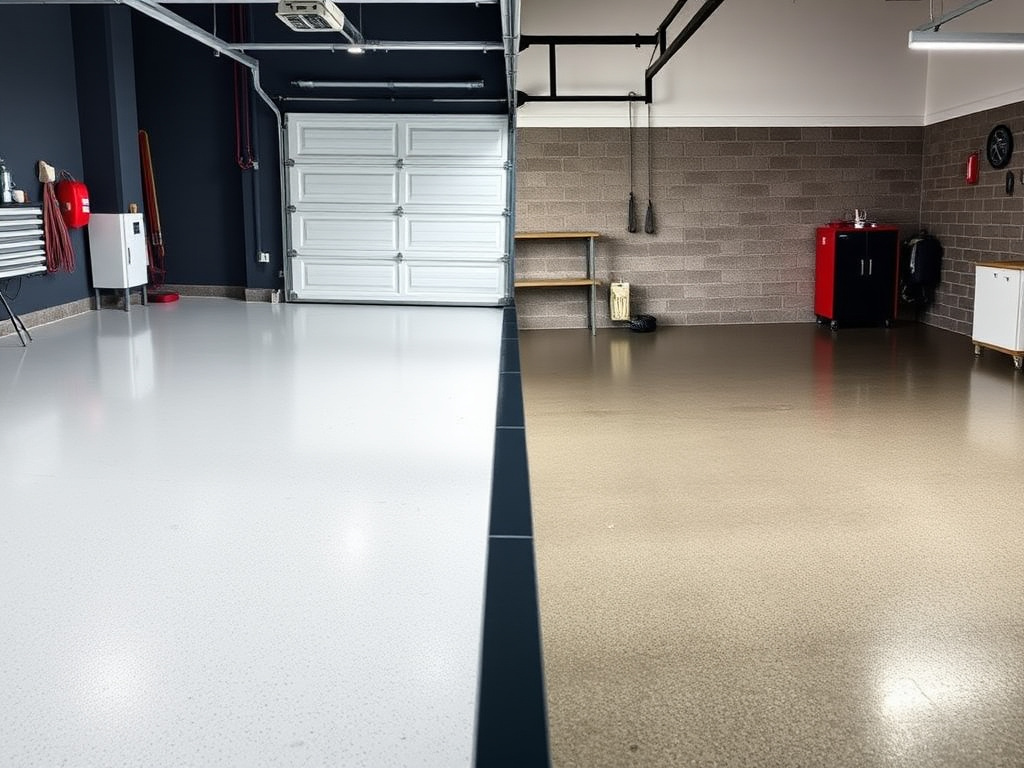
Coatings, compared honestly
Polyurea vs Epoxy Floor Coatings: An Honest Comparison for Florida
Both are real floor coating systems. Only one of them was built for a state with a six-month rainy season, year-round humidity and a UV index that spends most of the year in the 'extreme' range. Here's the side-by-side, without the sales pitch.
The quick answer
If you only read one section, read this one
For a Florida garage, pool deck, warehouse floor or truck bed, polyurea and polyaspartic systems outperform standard epoxy on nearly every spec that Florida's climate actually stresses: cure speed, humidity tolerance during application, UV stability once it's outdoors, and flexibility over a slab that's still settling slightly. Epoxy still has a place — mainly climate-controlled interiors and situations where upfront cost is the deciding factor — and we'll get specific about where it wins later on this page.
| Cure time (foot traffic) | Polyurea/polyaspartic: 1–4 hours. Epoxy: 24–72 hours. |
|---|---|
| Cure time (full cure) | Polyurea/polyaspartic: about 24 hours. Epoxy: 5–7 days. |
| Humidity / moisture tolerance | Polyurea can be applied in high ambient humidity and over slabs pushing moisture vapor. Epoxy is sensitive to both and can blush, cloud or delaminate. |
| UV stability | Aliphatic polyaspartic topcoats hold color outdoors. Standard epoxy is aromatic and ambers, yellows and chalks in direct sun. |
| Flexibility / crack bridging | Polyurea stays elastomeric and can bridge minor slab movement. Epoxy is rigid and will telegraph or crack over a moving joint. |
| Abrasion & impact resistance | Both perform well; polyurea generally shows better impact and scratch resistance under heavy use. |
| Install window | Polyurea: often a one-day, start-to-finish install. Epoxy: typically 2–4 days between prep, base coat and topcoat. |
| Typical installed cost | Epoxy: roughly $3–$7 per square foot. Polyurea/polyaspartic: roughly $7–$12 per square foot, installed. |
| Realistic service life | Epoxy: 5–10 years indoors, less with UV exposure. Polyurea/polyaspartic: 15+ years with normal wear. |
Typical ranges based on common Florida installation conditions. Actual figures vary by product line, prep, and site.
Cure time
One day vs most of a week
Polyurea and polyaspartic systems typically take foot traffic within a few hours and reach a full cure in about a day. Epoxy needs 24 to 72 hours before it can be walked on and 5 to 7 days before it's fully cured and ready for heavy use, chemicals or hot tires. In a state where a stalled sea-breeze storm can sit over the same county for three afternoons straight, that difference in cure time is the difference between one clean weather window and hoping for three in a row.
A slower cure also means more exposure time — more hours where dust, humidity, pets and foot traffic can compromise a coating before it has fully set up. Compressing that window from days to hours removes most of that risk by default, not through extra care on install day.
Moisture and humidity
Florida's humidity is exactly what breaks epoxy
Epoxy is chemically sensitive to both ambient humidity during application and moisture vapor rising up through a concrete slab afterward. High humidity while epoxy is curing can cause a hazy or blushed finish, and slab moisture vapor — extremely common on Florida ground-level slabs with a high water table underneath — can cause bubbling, cloudy patches, or the coating separating from the concrete months after install. That's why an epoxy installer in Florida has to test slab moisture, sometimes use a vapor-barrier primer, and watch the forecast for a dry window before starting.
Polyurea and polyaspartic systems are far more tolerant of both conditions. Many polyurea products can be applied in ambient humidity that would stop an epoxy job cold, and the chemistry is less reactive to slab moisture vapor migrating up from underneath. That doesn't mean slab prep and moisture testing disappear — good installers still test — it means the coating itself isn't working against the climate from day one.
UV stability
Aromatic vs aliphatic: the chemistry behind ambering
Standard epoxy resin is an aromatic chemistry, and aromatic compounds react to ultraviolet light by yellowing, ambering and eventually chalking on the surface. Under Florida's UV index — which sits in the "very high" to "extreme" range most of the year — that reaction happens fast on any epoxy left exposed outdoors. Indoors, behind glass and away from direct sun, the effect is much slower, which is exactly why epoxy is still a reasonable choice for an interior floor that never sees daylight.
Polyaspartic topcoats are an aliphatic chemistry, which is far more UV-stable and holds its color and clarity outdoors for years rather than months. That's the specific reason a pool deck, patio, driveway or marine coating gets specified with an aliphatic polyaspartic topcoat over a polyurea base rather than a plain epoxy — the base coat handles bonding and build, the topcoat handles the sun.
Flexibility and crack bridging
Florida slabs move. Rigid coatings crack with them.
Florida's soft, sandy soils and karst limestone bedrock mean slabs settle, shift and develop hairline movement over time even when nothing is structurally wrong. Epoxy cures into a hard, rigid film with very little elongation, so when the slab beneath it flexes even slightly, that stress has nowhere to go and shows up as a crack telegraphing straight through the coating.
Polyurea stays elastomeric after it cures, with enough elongation to stretch and flex with minor slab movement instead of splitting. That's not a substitute for fixing an actively settling slab — if a slab is sinking, coating over it is the wrong move regardless of which product is used — but for the ordinary hairline movement every Florida slab experiences over the years, a flexible topcoat simply ages better than a rigid one.
Heat and thermal cycling
90-degree afternoons, sudden downpours, and everything in between
A Florida driveway or pool deck can swing from baking in direct sun to being hit with a sudden afternoon downpour within the same hour, all summer long. That kind of rapid thermal cycling stresses the bond between a coating and the slab underneath, and it's harder on a rigid film than a flexible one for the same reason flexibility matters for slab movement — expansion and contraction need somewhere to go.
Polyurea's flexibility and faster thermal-recovery properties handle these swings with less long-term wear than a rigid epoxy film. Over a five- or ten-year span outdoors, that shows up as fewer hairline surface cracks and less edge lifting around drains, expansion joints and the perimeter of a pool deck.
Abrasion, impact, and chemical exposure
Both hold up. One holds up a little better.
Neither product is soft. A properly installed epoxy or polyurea system both resist everyday abrasion, hot tire pickup, and typical garage or shop chemicals like oil, gasoline, and cleaners reasonably well. Where they start to separate is under repeated impact — dropped tools, wheeled equipment, forklift traffic in a warehouse — where polyurea's greater elasticity lets it absorb an impact rather than chip or crack the way a harder epoxy film can.
For a light-duty residential garage, the difference may never come up in daily use. For a warehouse floor, a commercial kitchen, or secondary containment around industrial equipment, the abrasion and impact gap is a real factor in which system gets specified.
Being fair about it
The honest downsides of polyurea
Polyurea isn't automatically the right answer for every job, and a page built to sell polyurea over epoxy that pretends otherwise isn't being straight with you. Polyurea's fast cure comes from a short pot life — the material starts setting up within seconds to a couple of minutes once mixed, which means the installer has almost no room for error and needs real, practiced skill and the right plural-component spray equipment to lay it down evenly before it kicks off. An inexperienced crew can leave lap marks, texture inconsistencies, or thin spots trying to work too slowly against that clock.
Material and equipment costs are higher than epoxy, so the installed price is higher too — a real cost consideration, not a minor one, especially on a large square footage like a warehouse floor. And because fewer contractors are set up with the spray rigs and training polyurea requires, finding a genuinely qualified installer takes more vetting than finding someone who can roll out epoxy.
Where epoxy still wins
Epoxy isn't obsolete — it's situational
Epoxy remains a sound choice for deep-fill patching and self-leveling underlayment work, where its thicker, slower-curing build is actually an advantage for filling low spots before a topcoat goes down. It's also a reasonable, budget-conscious option for climate-controlled interior spaces — a finished basement, an indoor showroom, a retail floor — where UV exposure and humidity swings simply aren't in play the way they are on a Florida garage, patio or dock.
And for a homeowner whose top priority is the lowest upfront number on a straightforward, fully indoor floor with no moisture concerns, epoxy is still a legitimate, functional system — just one with a shorter realistic service life and more exposure to Florida's climate stresses if it ever sees a garage door left open to the weather.
What things actually cost
Cost per square foot, in real Florida ranges
Installed epoxy floor systems in Florida typically run somewhere around $3 to $7 per square foot, depending on prep work, number of coats, and whether a flake or quartz broadcast is included. Polyurea and polyaspartic systems typically run higher — roughly $7 to $12 per square foot installed — reflecting both material cost and the faster, more specialized labor required to apply it correctly.
Those are broad market ranges, not a quote — actual pricing on any project depends on square footage, existing slab condition, how much surface prep and repair is needed before coating, and the specific product build. The only way to get a real number is a site visit and a scoped, itemized quote for the space in front of you.
Read the fine print first
How to read a coating quote and spot corner-cutting
Two quotes that both say "epoxy floor coating" or "polyurea floor coating" can describe very different builds. Before comparing price, compare what's actually being installed.
Start a scoped quote- ✓Solids percentage — a coating diluted with more solvent lays down thinner and wears faster, even at the same price.
- ✓Total mil thickness across all coats, not just the topcoat — thin systems fail sooner under hot tires and foot traffic.
- ✓Surface prep method — mechanical diamond grinding or shot blasting bonds properly; an acid wash or light sanding often doesn't.
- ✓Number and type of coats — a base coat, broadcast, and a separate aliphatic topcoat is a different system than a single all-in-one coat.
- ✓Written warranty terms — what's actually covered, for how long, and what voids it, spelled out on paper rather than described verbally.
- ✓Cure schedule before return to service — a quote promising full use in hours should specify which product allows that and why.
Common questions
Polyurea vs epoxy: frequently asked questions
Is polyurea really better than epoxy, or is that just a sales line?
+
For Florida specifically, yes, in most of the ways that matter day to day: faster cure, better humidity tolerance during install, and topcoats that don't amber in the sun. Epoxy isn't a bad product — it's a product that was developed for a drier, more temperature-stable climate than Florida actually has.
What's the real difference between polyurea and polyaspartic?
+
Polyaspartic is a type of aliphatic polyurea chemistry — most of what gets marketed as a 'polyaspartic garage floor coating' is a polyurea-family topcoat. On this page, 'polyurea' covers both the base coats and the polyaspartic topcoats used over them, since that's how most Florida installers spec a system.
Can epoxy be fixed to perform better in Florida heat and humidity?
+
Some of it, with proper moisture testing, vapor-barrier primers, and installing only in a tight temperature and humidity window. That adds cost and schedule risk without closing the UV or flexibility gap, which is chemistry, not installation.
Does a polyaspartic topcoat over epoxy solve the UV problem?
+
It helps the color hold on top, but the epoxy base underneath is still the rigid, moisture-sensitive layer doing the structural bonding to the slab. It's a partial fix, not the same system as a full polyurea build.
Polyurea Garage Floor Coatings
One-day polyaspartic flake systems built for Florida humidity and hot-tire pickup.
Pool Deck & Patio Coatings
UV-stable, slip-resistant polyaspartic finishes for full Florida sun and pool chemistry.
Still have questions about the process, timelines or pricing? Visit the FAQ page or go straight to a scoped quote request.
Get a scoped quote — polyurea or epoxy, either way
Tell us the space, the current floor condition and what it needs to survive. We'll recommend the right system for the job, not just the one we'd rather sell.