Driveways · Sidewalks · Walkways
Driveway, Sidewalk & Walkway Concrete Leveling in Florida
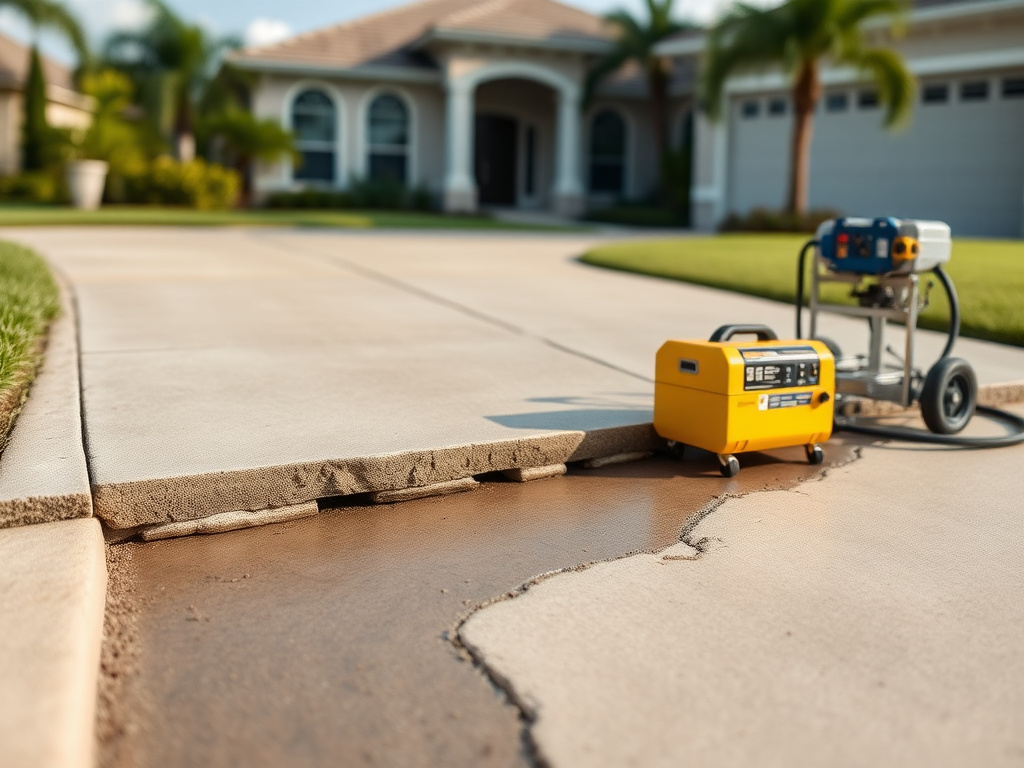
Sunken driveway sections and tripping sidewalk panels are two of the most common concrete calls we get statewide. Polyurethane injection lifts the affected panel back toward grade in under a day — no jackhammering, no dumpster, no waiting on a new pour to cure.
Why this happens
Driveways and walkways are usually the first concrete to sink
On the same property, a driveway or a stretch of sidewalk will almost always show settlement before the house slab does, and there are ordinary, explainable reasons for it. Driveway and walkway sections are poured thinner than a structural foundation slab, they carry far less reinforcing steel, and they sit right at grade where they take the full brunt of Florida's wet-season soil movement.
Edge erosion is the other half of it. The soil under the outer few inches of a driveway or walkway panel washes out first, from runoff, from grading that slopes the wrong way, or simply from years of rain finding the same path. Once that support is gone, the edge or corner of the panel has nothing left to hold it, and it drops.
Irrigation and sprinkler overspray add to it in a way most homeowners never connect to the crack in their driveway. A sprinkler head that clips the edge of a slab every morning is quietly saturating the base soil underneath it, and saturated Florida soil compacts and shifts far more than dry soil does. Over a few seasons, that one sprinkler head can be the entire reason a single panel is an inch and a half lower than the one next to it.
Common early signs
- ✓A panel edge or joint that's visibly lower than its neighbor
- ✓Standing water pooling on one section after rain
- ✓A gap opening up where two panels used to sit flush
- ✓A driveway seam that's started catching a car door or stroller wheel
HOAs, property managers & municipalities
A trip hazard is a maintenance item, not a marketing problem
For HOAs, property management companies and municipal facilities teams, a lifted or sunken sidewalk panel is a straightforward maintenance and inspection item: it needs to be found, documented and corrected before someone catches a toe on it. Most managed communities and public rights-of-way get periodic walkway inspections for exactly this reason, and a raised or sunken joint that shows up on that inspection typically goes on a repair list with a timeline attached.
We work directly with property managers and HOA boards to knock out an entire inspection list in one mobilization — walking the property, documenting every panel that needs attention, and lifting them in sequence rather than sending a crew back out panel by panel. That's almost always faster and less disruptive to residents than patch repairs done one complaint at a time.
None of this requires guessing at code language you're not a specialist in. If your community or facility has a specific inspection standard or a local building department requirement for walkway surfaces, tell us what it is and we'll scope the repair to match it. Where no formal standard applies, we work from a simple, defensible rule: no panel-to-panel offset that a pedestrian could realistically catch a foot on.
How the lift works
Re-leveling a driveway or sidewalk panel in under a day
Polyurethane injection is a five-step process from the first measurement to a drivable, walkable surface, and most single-panel or single-driveway jobs finish in one visit.
Mark & measure
The crew identifies the low panels, measures the actual elevation difference, and locates joints and control cuts before drilling anything.
Drill entry points
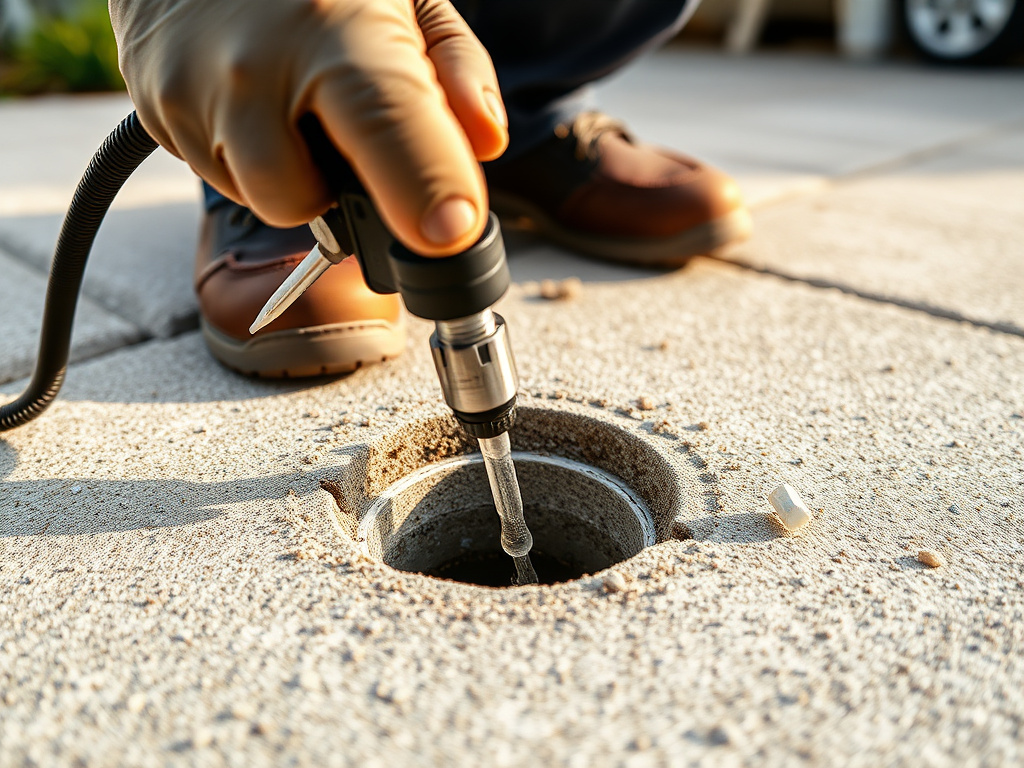
Small entry holes — typically around the diameter of a coin — are drilled at calculated points in the sunken panel or slab.
Inject & lift
Expanding polyurethane is pumped beneath the slab in controlled lifts, raising the panel back toward grade while a crew member monitors elevation in real time.
Check the grade
Elevation is verified against the adjoining panels and any drainage slope the walkway or driveway is supposed to hold.
Patch & finish
Entry holes are patched, joints are cleaned, and the surface is ready to walk or drive on within a couple of hours in most cases.
Panel by panel
We lift the panel that's sunk — not the whole run
A driveway or sidewalk is a series of individual panels separated by control joints, and it's rare for every panel in a run to sink at the same rate. One of the real advantages of polyurethane injection over a full tear-out is that we can lift a single panel — or a single driveway apron, or one corner of a patio — without touching the panels around it.
That matters for the joints themselves. Because the lift targets one panel at a time, we can dial in the exact amount of foam that panel needs to come back to the correct elevation and slope, then check it against the panels on both sides before moving to the next section. The rest of the driveway or walkway keeps its existing color, texture and finish — there's no patchwork of old and new concrete the way there is with a partial replacement.
What it typically costs
Cost per panel, and what a whole driveway typically runs
Pricing is driven by square footage, the amount of lift a panel needs, and how many access points the job requires — so treat the ranges below as typical Florida market ranges, not a quote for your specific driveway. Polyurethane lifting generally runs about $5 to $25 per square foot depending on those factors, compared with roughly $3 to $8 per square foot for traditional mudjacking, which uses a heavier cement-based slurry that can add new load to already-soft Florida soil.
A single sunken sidewalk panel or a small driveway apron can start from around $500. A typical whole-driveway or patio-scale leveling project usually lands in the $1,700 to $4,000 range. Larger commercial walkway or parking-area lifts can run into the tens of thousands, since those are priced against total square footage and the number of individual panels involved.
$5–$25
Per sq ft, polyurethane lift
$500+
Small single-panel jobs from
$1.7K–$4K
Typical driveway project
Same Day
Most lifts complete
After the lift
Sealing and re-caulking the joints
Lifting the slab back to grade doesn't fix the reason water was getting under it in the first place. Once a panel is releveled, we clean out the control joints and expansion joints around it and re-caulk them with a flexible polyurethane sealant, so rain and irrigation runoff can't keep washing sand and fines out of the base material underneath.
This step is quick, but skipping it is one of the most common reasons a do-it-yourself or bargain lift settles again within a year or two. A properly sealed joint keeps the base soil under the panel at a stable moisture level, which is exactly the condition that keeps a lifted panel staying level.
Managed communities
HOA and community approval
If you live in an HOA or a deed-restricted community, driveway and walkway work sometimes needs a quick architectural review before a crew shows up — mostly to confirm the finish and color will match the existing concrete, since polyurethane lifting doesn't change the surface itself. We can put together simple before-and-after photos and a short project description to support that request if your board or management company asks for one.
Whether or not your community requires that step is specific to your HOA's own governing documents, so check with your management company or board first. Separately, most Florida driveway and sidewalk leveling work doesn't trigger a building permit, since it's a repair rather than new construction — but permit rules vary by county and city, so confirm with your local building department if you want it in writing before work starts. See our FAQ page for more on permits and HOA approval patterns.
Keep it from happening again
Preventing the next sunken panel
A lift solves the panel that's already down. Preventing the next one usually comes down to managing water around the slab, since erosion and saturation are the two things that cause driveway and walkway settlement in the first place.
- ✓Regrade soil along the driveway or walkway edge so water sheds away from the slab, not toward it
- ✓Add a French drain along a chronically wet edge to move groundwater away before it saturates the base
- ✓Extend downspouts so roof runoff discharges well past the slab edge instead of soaking directly beneath it
- ✓Redirect or retime sprinkler heads that spray directly onto driveway or walkway edges
When it's more than a driveway
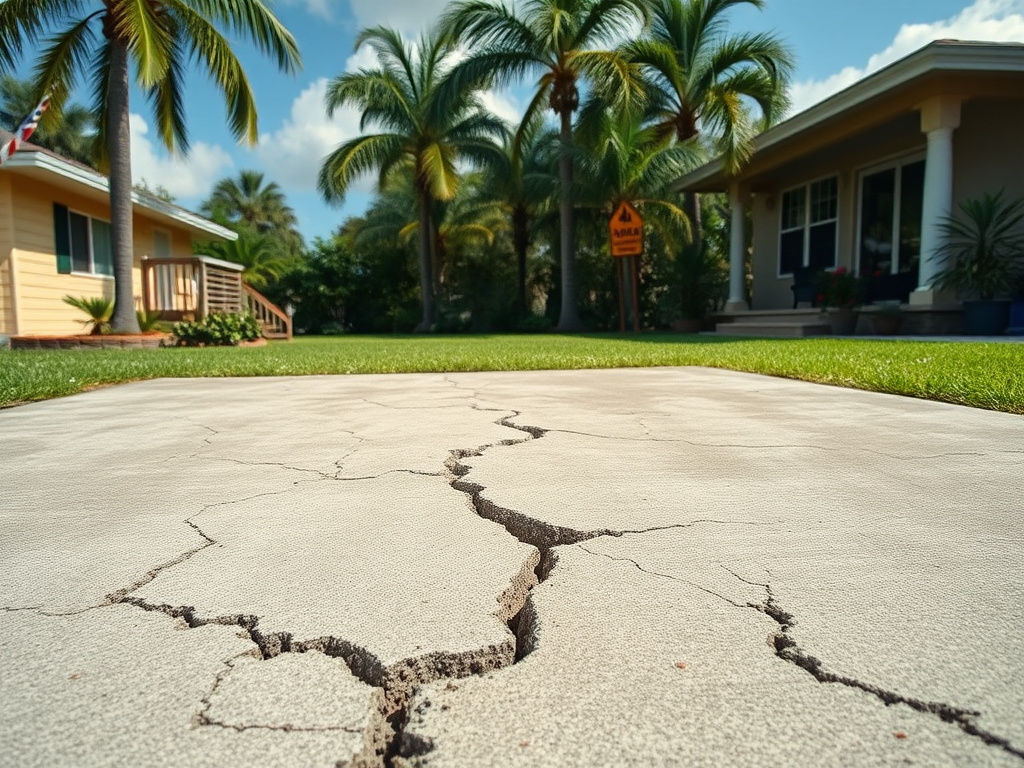
Repeated settlement, a panel that keeps dropping after a lift, or sinking that extends into the yard beyond the slab edge can point to a larger settlement issue rather than ordinary edge erosion.
Sinkhole & settlement concrete repair →How concrete lifting works, in depth →Get your driveway or sidewalk quote
Tell us which panels are low and how bad the trip hazard is. Most driveway and sidewalk lifts are scoped and scheduled within days.