Frequently Asked Questions
Polyurea Coating & Concrete Lifting FAQs — Florida
Straight answers on Florida sinkholes and settlement, no-demolition concrete lifting, coating costs, humidity and hurricane durability, permits, and pool deck and marine coating systems — pulled from the questions we hear most on inspections across the state.
Sinkholes & Florida Geology
Why Florida sinks — and how to tell the difference
Karst geology makes settlement a statewide fact of life, not just a west-coast problem. Here's how to read the warning signs and what happens once a void is confirmed.
Why does Florida have so many sinkholes?
+
Much of Florida sits on top of karst geology — layers of limestone and dolomite that slowly dissolve when acidic groundwater moves through them. Over decades that dissolution carves out underground voids and cavities beneath the soil. When the layer of sand and clay covering one of those voids can no longer support its own weight, it collapses or slowly subsides into the gap below, and that settlement shows up at the surface as a sinkhole, a sunken slab, or a depression in the yard.
Which parts of Florida have the most sinkholes?
+
The west-central corridor often called "Sinkhole Alley" — Pasco, Hernando, Hillsborough, Polk, Marion, and Alachua counties — sees the highest concentration of confirmed sinkhole activity in the state, and Pasco County specifically has one of the highest per-capita sinkhole rates anywhere in the United States. This region sits over a shallower, more soluble limestone layer with a fluctuating water table, which is exactly the combination that produces active karst collapse.
Is my house at risk if I don't live in "Sinkhole Alley"?
+
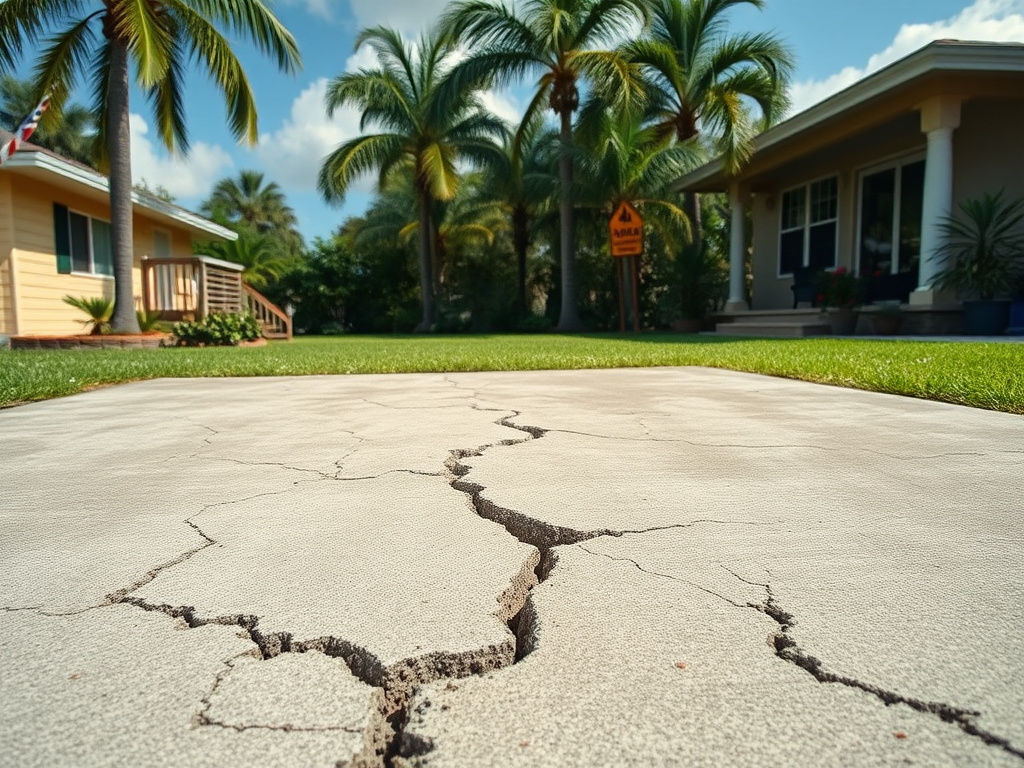
Yes, just from a different mechanism. Outside the west-central corridor, true sinkhole collapse is far less common, but soft or poorly compacted fill soil and Florida's naturally high water table cause plenty of concrete settlement on their own. South Florida — Miami-Dade, Broward, and Palm Beach counties — has low sinkhole incidence but still sees significant settlement-driven cracking and sinking in driveways, patios, and slabs because of soil composition and moisture, not karst dissolution. The repair approach is similar either way.
How do I know if I have a sinkhole vs normal settlement?
+
Warning signs worth taking seriously include stair-step cracks in walls or foundations, doors and windows that suddenly stick or won't latch, visible depressions or dimples forming in the yard, and fences or sheds that have noticeably shifted or tilted. An inspection looks at the pattern and location of that damage, checks whether cracks are widening or stable, and evaluates soil and slab conditions around the affected area to determine whether it's isolated settlement or something that points to a deeper void.
Can a sinkhole be fixed, or does the property need to be abandoned?
+
The large majority of confirmed voids and settlement areas can be stabilized without abandoning the property, using a combination of structural fill to pack the void and polyurethane injection to compact loose soil and support the slab above it. Abandonment is rare and only comes up in the most severe, actively collapsing cases. When a void appears to extend well beyond what fill-and-injection repair can safely address, that's exactly when outside engineering assessment gets brought in before any repair work proceeds.
Do you work with structural engineers or geotechnical firms?
+
Yes. When an inspection turns up a confirmed active void, or damage that looks like it extends into the structural footing or foundation itself rather than just the surface slab, we coordinate with independent structural engineers and geotechnical firms to properly assess it. Concrete lifting and injection repair have real limits, and we'd rather bring in that outside expertise than push a repair past what it's designed to fix.
Seeing cracks, a shifting fence line, or a depression forming in the yard? Start with our sinkhole & settlement concrete repair page for how we diagnose and stabilize it.
Concrete Lifting vs. Replacement
How polyurethane lifting works, and when it's the right call
Most sunken slabs can be lifted in a single day without demolition. Here's the process, the honest comparison to mudjacking, and where lifting stops making sense.
How does polyurethane concrete lifting work?
+
We drill a series of small injection holes — typically about the diameter of a coin — through the sunken slab in a planned pattern. A two-part polyurethane material is pumped through those holes underneath the concrete, where it expands and hardens within minutes, filling voids, compacting loose soil, and lifting the slab back toward level. The holes are then patched, and there's no jackhammering, no demolition, and no heavy equipment tearing up the surrounding yard or driveway.
Is polyurethane lifting better than mudjacking in Florida?
+
For Florida's soft, wet soils, polyurethane generally holds up better. The expanding foam material is extremely lightweight and resists absorbing moisture, so it doesn't add meaningful load to soil that's already struggling to support the slab. Mudjacking uses a heavy cement-based slurry that can weigh many times more per cubic foot — on soil that's already saturated or loosely compacted, that added weight can contribute to the same settlement happening again down the road.
How long does a lifted slab stay level?
+
A properly performed lift can hold for many years, but realistic expectations depend on what's happening underneath and around the slab. Good site drainage and grading that keeps water moving away from the area go a long way toward keeping it stable. If the underlying soil has ongoing settlement risk — a slow leak, poor grading, or a nearby void that wasn't fully addressed — some future movement is possible, which is why we look at drainage and root cause, not just the lift itself.
Can you lift a slab that's cracked, not just sunken?
+
In most cases, yes — a cracked but otherwise intact slab can still be lifted and leveled through injection, and the crack itself can typically be sealed as part of the repair. Where we'd recommend replacement instead is when a slab is severely fragmented, has crumbling or spalling edges, has exposed and corroded rebar, or is cracked into pieces that move independently of each other. At that point the slab has lost the structural integrity needed to be lifted as one piece.
Is concrete lifting cheaper than replacing the slab?
+
In almost every case, yes, and usually by a wide margin. Polyurethane lifting typically runs in the range of about $5 to $25 per square foot depending on slab size, access, and how much lift is needed, with most residential projects landing somewhere around $1,700 to $4,000 total and small jobs starting from roughly $500. Demolition and full slab replacement involves breaking out and hauling away the old concrete, re-grading, and repouring — costs that stack up fast and make lifting the more economical choice whenever the existing slab is structurally sound enough to lift.
Can you lift a pool deck without draining the pool?
+
Yes, in the vast majority of cases. Injection points are placed in the deck itself, working around the pool shell rather than through it, so the pool typically stays full and in use throughout the process. Access around tight coping, water features, or screen enclosure posts sometimes changes the injection pattern slightly, which is exactly what an on-site inspection is for — to plan around those obstacles before any drilling starts.
How long before I can walk or drive on a lifted slab?
+
Foam-injection lifting cures fast — most residential slabs can be walked on almost immediately and are typically ready for vehicle traffic the same day, often within a couple of hours of the work finishing. Larger commercial slabs or unusually deep lifts may need a bit more cure time before heavy equipment or truck traffic returns, which we'll spell out specifically for the job in question.
Will lifting fix the cause of the sinking, or just the symptom?
+
Lifting corrects the visible problem — the slab sitting where it should — but it doesn't automatically fix poor drainage, bad grading, or a downspout dumping water next to the foundation, which are common root causes of settlement in the first place. When an inspection turns up one of those contributing factors, we'll flag it and recommend addressing it alongside the lift, because leaving the underlying moisture or grading issue in place raises the odds of the same settlement recurring.
For the full process and timeline, see concrete lifting & slab leveling. Not sure whether your slab qualifies for lifting or needs a full pour? Compare lifting vs. slab replacement.
Cost
What lifting and coating projects actually cost in Florida
Typical market ranges for concrete lifting and garage floor coatings, what raises the price, and how to spot a quote that's cutting corners.
How much does polyurethane concrete lifting cost in Florida?
+
Typical market pricing runs about $5 to $25 per square foot, with the exact number depending on how much material is needed, how deep the void or settlement is, and how accessible the area is. Most single-slab residential jobs — a driveway section, a walkway, a small patio — land in the roughly $1,700 to $4,000 range, with small isolated repairs starting around $500. Larger commercial or industrial slab-lifting projects, where square footage and material volume scale up significantly, can run into the $20,000-plus range.
How much does a polyurea garage floor coating cost?
+
Pricing scales mainly with square footage and prep requirements. A typical two-car garage floor generally costs less than a three-car or oversized garage simply because there's more surface area to prep, prime, and coat. Costs move higher when the existing slab has heavy oil staining, cracks that need to be routed and filled first, or high moisture-vapor readings that require additional vapor-mitigation steps before the coating system goes down — all things an on-site inspection accounts for before quoting.
Is a cheap concrete-lifting quote a red flag?
+
It can be, if the low price comes from cutting the parts of the job that actually make a lift last. Warning signs include vague specifics on the foam density or material being used, an injection pattern that seems too sparse to properly support the slab, and no plan for a post-lift inspection to confirm the slab actually settled at the intended level. A thorough quote should walk through the injection pattern, material, and what happens after the lift — not just a single flat number.
Do you charge for the initial inspection?
+
No. We provide a free, no-obligation on-site inspection and written estimate before any work begins. That visit is where we look at the slab, the surrounding grading and drainage, and any warning signs of an underlying void, and put together a scoped, itemized number for the repair or coating work — with no pressure and no cost to you for that first look.
Want a scoped, itemized number for your own slab or floor? Start a free quote and we'll follow up with specifics, not a guess.
Humidity, Heat & Hurricane Durability
Why coating chemistry matters in Florida's climate
Humidity, UV, and storm-season flooding are exactly the conditions polyurea and polyaspartic systems are engineered around — here's why that matters versus epoxy.
How long does polyurea coating last in Florida's humidity?
+
Polyurea and polyaspartic coatings are formulated specifically to handle high-humidity, high-UV climates, curing into a dense, flexible film that resists moisture intrusion far better than standard epoxy. Epoxy systems are more prone to moisture-vapor problems, blushing, and amine blush in humid conditions, and standard epoxy also breaks down faster under intense Florida sun. A properly installed polyurea system is built to hold its finish and bond significantly longer in this climate than a comparable epoxy-only system.
Will my garage floor coating hold up during hurricane season?
+
Polyurea's low moisture sensitivity is a real advantage during hurricane season, when garages and floors are more likely to see standing water, wind-driven rain, or humidity spikes. The coating itself resists water intrusion and won't easily blister or delaminate from brief flooding exposure the way some moisture-sensitive coatings can. If a garage or floor does take on standing floodwater during a storm, the right move afterward is to clear the water and debris promptly and have the surface inspected — not because the coating is fragile, but because prolonged saturation of the slab underneath is worth checking regardless of what's on top of it.
Does Florida humidity cause coatings to fail during installation?
+
It can, if installation isn't managed around it — humidity and dew point directly affect how a coating cures and bonds to the slab. Applying certain coatings when the surface temperature is too close to the dew point traps moisture vapor at the bond line, leading to bubbling, poor adhesion, or a hazy finish. That's why proper installation involves checking moisture-vapor emission and surface conditions before application and timing the job — often scheduling around the time of day or humidity window — rather than coating on a fixed calendar date regardless of conditions.
Will the coating turn yellow or chalky in Florida sun?
+
That depends heavily on the topcoat chemistry. Aromatic polyurea and polyurethane resins are durable but chemically prone to UV yellowing and surface chalking with sustained sun exposure — fine for a base coat that will be covered, but not ideal as a final finish. Aliphatic topcoats are formulated to resist that UV breakdown and are what's used as the finish layer on floors, decks, and surfaces that stay exposed to direct Florida sun, which is why the topcoat chemistry matters as much as the base material.
Can you install during the rainy season?
+
Yes — Florida's wet season doesn't shut down installation, it just changes the scheduling. Work gets planned around humidity and dew-point windows, often earlier in the day or during drier stretches between afternoon storms, and surface moisture is checked before any coating goes down. Indoor spaces like garages and warehouses are easier to control for timing than fully exposed outdoor decks, but both can be scheduled successfully around Florida's rainy-season patterns with the right prep.
For a full side-by-side on chemistry and lifespan, read polyurea vs. epoxy for Florida conditions.
Permits & HOA
Permits, HOA approval, and waterfront rules
General guidance on when permits and HOA sign-off typically come into play — always confirm specifics with your local jurisdiction or association.
Do I need a permit to lift or level concrete in Florida?
+
It depends on the scope of the work and your local jurisdiction. Routine polyurethane lifting and leveling of existing driveways, sidewalks, and patios is generally treated as repair work and typically doesn't require a permit in most areas, since it doesn't involve new structural construction. Work that crosses into structural repair — foundation-related injection, or anything tied to a building's footing — is more likely to need local sign-off. Because rules vary by county and city, we always recommend confirming with your local building department for anything beyond straightforward slab leveling.
Does my HOA need to approve a driveway or pool deck coating?
+
Many Florida HOAs do require some form of notice or approval before exterior work like a driveway resurface or pool deck coating, particularly around color choices, sheen, or anything visible from the street or common areas. Requirements vary widely between communities. We can help by providing documentation, photos, and material or color specifications for your HOA submission, which makes that approval process faster and more straightforward on your end.
Do dock or seawall coatings require environmental or waterfront permitting?
+
Often, yes — waterfront and marine work tends to carry additional layers of local and environmental permitting that inland concrete or coating work doesn't, since docks, seawalls, and shoreline structures can fall under local waterfront ordinances or environmental review depending on the property and jurisdiction. Rather than assume a blanket rule, we recommend checking with your local building or environmental authority for any dock or seawall project, and we're happy to help identify what documentation a given job is likely to need.
Leveling a driveway or sidewalk panel and want to know what documentation to expect? See driveway & sidewalk leveling.
Pool Decks, Marine & Commercial
Coating systems for water, salt air, and working kitchens
From pool coping to tidal seawalls to a restaurant that can't afford to close, here's how coating choice changes with the environment.
What's the best coating for a Florida pool deck?
+
A UV-stable, slip-resistant polyaspartic system is generally the strongest option for Florida pool decks. Unlike standard acrylic or "cool deck" style coatings, which tend to wear, fade, and lose their texture over a few seasons of full sun and pool chemical exposure, polyaspartic topcoats hold their color and slip resistance much longer while standing up to constant UV, splashing, and foot traffic around the water's edge.
Can you coat a dock or seawall that's partially submerged at high tide?
+
Yes — that tidal splash zone is actually one of the more demanding environments a coating can face, since the surface cycles between wet and dry, submerged and exposed, throughout the day. We use a seamless polyurea membrane system specifically because it handles that repeated wet-dry, submerged-exposed cycling without seams or joints where water can work its way in, which is the failure point for less flexible coating systems in that zone.
Will a boat lift or dock coating hold up to saltwater?
+
Polyurea systems are chemically resistant to the corrosive effects of saltwater exposure, which makes them well suited to boat lift components, dock decking, and other marine hardware that sits in a constant salt-air and splash environment. The seamless, flexible membrane also resists the cracking and lifting that rigid coatings can develop from the expansion and contraction that comes with temperature swings and wet-dry cycling near the water.
Can you coat a commercial kitchen or restaurant floor without shutting down service?
+
In most cases, yes. Polyurea and polyaspartic floor systems cure fast enough that we can schedule application during overnight or off-hours windows, coating in sections if needed so the kitchen can reopen for service on a normal schedule. These systems are also built to handle the grease, heat, and constant sanitation exposure of a commercial kitchen, which is exactly the environment they're formulated for.
Explore pool deck & patio coatings or marine, dock & seawall coatings for system specifics.
Still have questions?
Call, text, or start a quote — we'll walk your slab or floor in person and give you a straight, itemized number before any work begins.