Concrete Lifting & Leveling
Polyurethane Concrete Lifting — The Modern Mudjacking Alternative for Florida
Small injection holes, expanding structural foam, and a slab that's level again the same day — no jackhammers, no dumpster, no week of waiting for a repour to cure.
The Florida Soil Problem
Why Florida Concrete Sinks in the First Place
Concrete doesn't sink on its own — the ground underneath it does. Most Florida slabs were poured on fill soil that was never fully compacted, or on native sand that shifts once water starts moving through it. Add a few years of irrigation overspray and downspout runoff washing fine soil particles out from under a slab edge, and you get the classic sunken driveway corner or dipping patio panel.
A high statewide water table makes the problem worse almost everywhere, because saturated soil compresses and shifts more than dry soil ever will. In the west-central corridor — Pasco County, which has the highest per-capita sinkhole rate in the country, plus Hernando, Hillsborough, Polk, Marion and Alachua counties — porous limestone and dolomite bedrock sits under that soil. Acidic groundwater slowly dissolves the rock, hollowing out underground voids that eventually collapse and take the soil, and the slab, down with them.
Southeast Florida — Miami-Dade, Broward, Palm Beach — sees comparatively little of that sinkhole activity. Its concrete problem is different: soft fill soils and a high water table drive ordinary settlement instead, made worse by coastal and hurricane exposure. Different mechanism, same result — a slab that no longer sits level.
None of this is unique to old neighborhoods, either. New-construction homes settle too, because fill placed and compacted quickly during a build can take years to finish consolidating under the weight of a slab. A driveway or garage floor that looked perfect at closing can start showing a low corner well before the house is paid off, and that's a soil issue, not a workmanship defect in the original pour.
The Method
What Polyurethane Concrete Lifting Actually Is
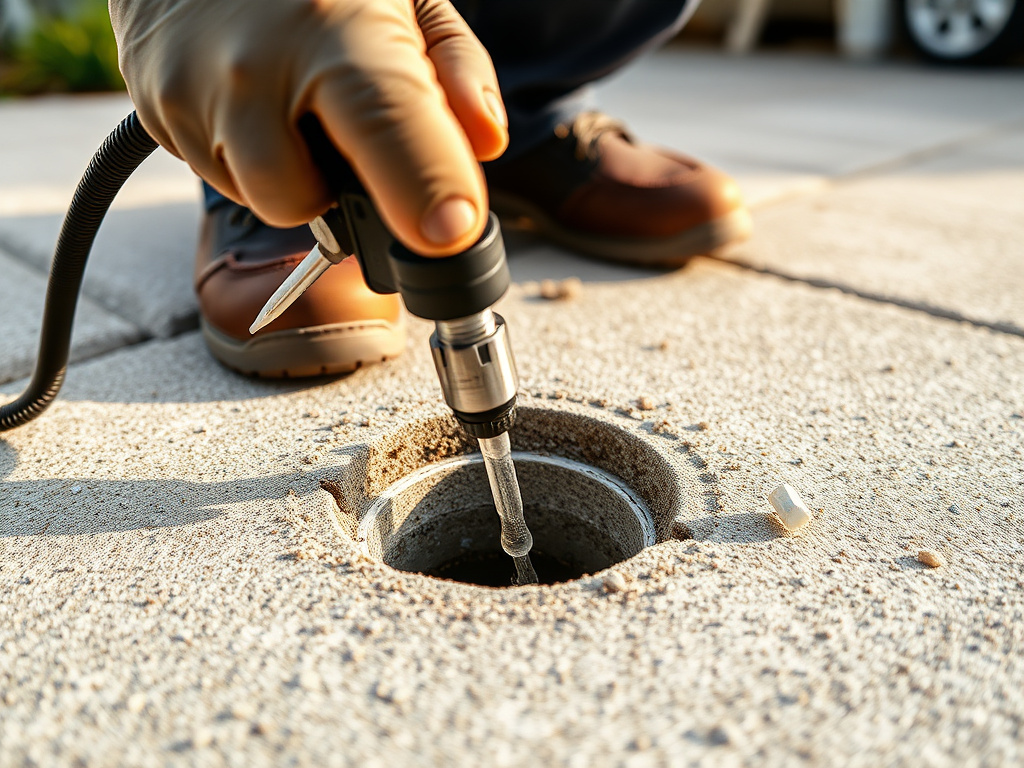
Polyurethane concrete lifting — also called foam injection or slabjacking — raises a sunken slab back toward its original grade by pumping expanding structural foam into the void or loose soil underneath it. The process is fast, precise, and leaves almost no footprint on the surrounding landscaping.
Inspect & Mark
We walk the slab, take elevation readings, and mark the low spots that need lift.
Drill Small Holes
Holes roughly the size of a dime go in at calculated points across the affected area.
Inject Structural Foam
Expanding, closed-cell polyurethane is pumped beneath the slab through those holes.
Lift Within Minutes
The foam expands and cures fast, raising the slab back toward grade in minutes, not days.
Patch & Walk On It
Injection points are patched flush and the slab is ready for foot and vehicle traffic the same day.
Foam vs Mud
Why Polyurethane Outperforms Mudjacking on Florida Soil
Traditional mudjacking lifts a slab with a heavy cement-and-soil slurry pumped through larger holes. It works, but that slurry adds substantial new weight right back onto the same soil that already failed once. In sandy, saturated, or fill-heavy ground — which describes most building sites in Florida — that added weight can compress the soil further and let the slab settle again within a few seasons.
Polyurethane foam weighs a fraction as much, resists moisture rather than absorbing it, and cures within minutes instead of hours. It adds far less new load to soft or wet soil, which is exactly the soil profile Florida contractors deal with on almost every job.
| Material weight added to soil | Polyurethane: a few pounds per cubic foot. Mudjacking: a heavy cement-and-soil slurry. |
|---|---|
| Typical cure / set time | Polyurethane: minutes. Mudjacking: hours to a full day before load-bearing use. |
| Hole size | Polyurethane: roughly 5/8 inch. Mudjacking: 1 to 2 inches, more visible after patching. |
| Behavior in wet or soft soil | Polyurethane resists water intrusion and adds minimal new load. Mudjacking's slurry can re-saturate and settle again. |
| Best fit for Florida's soil profile | Polyurethane, on the sandy fill soils and high water tables found across most of the state. |
General comparison. Actual performance depends on soil conditions confirmed during inspection.
Curious how lifting stacks up against tearing out and repouring the slab entirely? Read our full concrete lifting vs. slab replacement comparison.
Applications
What We Lift and Level
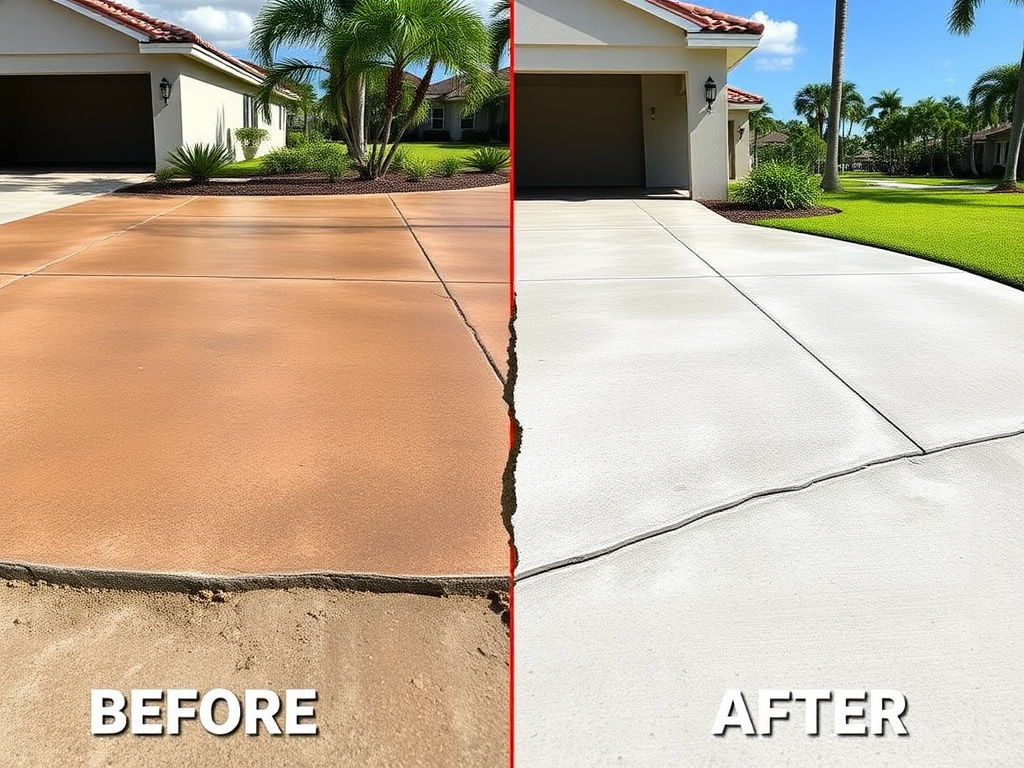
If it's a concrete slab resting on soil, there's a good chance we can lift it. The most common calls we get across Florida are:
- ✓Driveways and drive aprons
- ✓Sidewalks and walkways
- ✓Garage floor slabs
- ✓Pool decks and lanais
- ✓Patios and porches
- ✓Entry steps and stoops
- ✓Warehouse and industrial floor slabs
- ✓HOA and community common-area concrete
Diagnosis First
How We Tell Settlement From an Active Sinkhole Void
Before any hole gets drilled, we inspect. That means mapping crack patterns across the slab, taking elevation readings at multiple points, and probing suspected soft spots to get a sense of what's actually happening underground. Isolated, gradual settlement from soil compaction or erosion behaves differently than a slab sitting over a growing void in the karst bedrock below — the cracking pattern, the rate of change, and the depth readings all tell a different story.
When an inspection points to a confirmed void rather than ordinary settlement, we say so plainly and walk you through what that means for the repair. For the full picture on how we diagnose and repair sinkhole-related damage — including when we bring in outside geotechnical partners — see our page on sinkhole and settlement concrete repair.
No Jackhammers
Same-Day Lifting Beats Tear-Out for Most Homes
Demolishing and repouring a slab means a jackhammer crew, a dumpster parked in the driveway for days, disturbed landscaping and irrigation lines, forms and rebar, a pour, and then a curing period before anyone can drive on it again. For the majority of residential settlement — a sunken driveway panel, a dipping pool deck corner, an uneven walkway — that's a lot of disruption to fix a problem that lifting solves in a few hours.
Polyurethane injection leaves the original slab intact, keeps your landscaping and irrigation undisturbed, and gets the surface back in service the same day. Replacement still has its place — we'll tell you when your slab is genuinely past saving — but it's the exception, not the default.
There's a cost angle here too, not just convenience. Demolition, disposal, forms, rebar, a full concrete pour and a curing period add up fast in labor and material alone, before you factor in a dumpster rental or landscaping repair. Lifting the existing slab typically runs a fraction of that total, which is exactly why it's the first option we evaluate rather than the last.
What It Costs
Florida Concrete Lifting Cost Ranges
These are typical Florida market ranges, not a quote for your slab — the numbers below come from inspection, void size, depth, and access, not a fixed price list.
$5–$25
Per sq ft, polyurethane lifting
$3–$8
Per sq ft, mudjacking (for comparison)
$1,700–$4,000
Typical whole-project range
$500+
Small single-slab jobs
Void size and depth drive most of the variation — a shallow, isolated soft spot under a walkway costs far less to correct than a deep void spanning a two-car driveway. Access matters too: a slab a rig can pull straight up to is cheaper to reach than a gated-community driveway or a pool deck with limited equipment clearance. Large commercial slabs with extensive settlement can run well into the $20,000-plus range once structural fill and a full injection grid are involved.
The Honest Limits
What Polyurethane Lifting Can't Fix
Lifting works by filling and stabilizing the soil or void beneath a slab that's otherwise sound. It isn't the right tool for every job. An active, unstabilized void that's still growing typically needs structural fill placed first, so the slab has something solid to rest on rather than foam bridging an open cavity. Foundation-level problems — cracked footings, failing structural framing, movement in the house itself rather than the slab in front of it — are a job for a structural engineer, not a concrete-lifting crew.
And a slab that's badly shattered, crumbling, or missing large sections of material simply doesn't have enough intact concrete left to lift. In any of these cases, we'll say so during the inspection rather than sell a lift that won't hold.
This is also where a second opinion earns its keep. If a contractor quotes a lift without ever probing the soil or checking whether the void underneath is still active, that's a corner being cut, not a shortcut you benefit from. An honest inspection takes the time to rule those scenarios out before any foam goes in the ground.
After the Lift
Aftercare: Sealing, Monitoring, and When to Call Us Back
Once a slab is lifted, we patch the injection points flush and reseal the surrounding control joints so water can't re-enter and erode the soil we just stabilized. We'll also flag anything we noticed during the visit that's likely to cause trouble again — a downspout dumping water at the slab edge, an irrigation head spraying directly against the foundation, grading that slopes the wrong way.
A properly lifted slab on properly stabilized soil should hold for years. If you ever notice new cracking, a returning dip, or a gap reopening at the same spot, call us back — that's exactly the kind of change worth a follow-up look rather than something to wait out.
Seasonal changes are worth watching too. Florida's wet season saturates soil that was dry all spring, and a slab that held level through a dry winter can show its first sign of renewed movement during the first heavy summer storms. That's not a failed lift — it's a reason to keep an eye on drainage around the slab edge year-round, not just right after the repair.
Get Started
Warranty-Backed, Statewide Availability
Every lift we perform is backed by a written workmanship warranty, and we travel statewide — from the Panhandle to the Keys corridor — with priority scheduling for the west-central Sinkhole Alley counties where settlement calls run heaviest. If your driveway needs panel-by-panel attention rather than a whole-slab lift, our driveway and sidewalk leveling page covers that in more detail, and our Florida service area page breaks down response times by region.
The first step is always the same: a free, no-obligation inspection where we measure, diagnose, and give you a written, itemized number.
Get a free concrete lifting inspection
Tell us what's sunken, cracked or uneven. We'll come back with a scoped, itemized number — no demolition required in most cases.