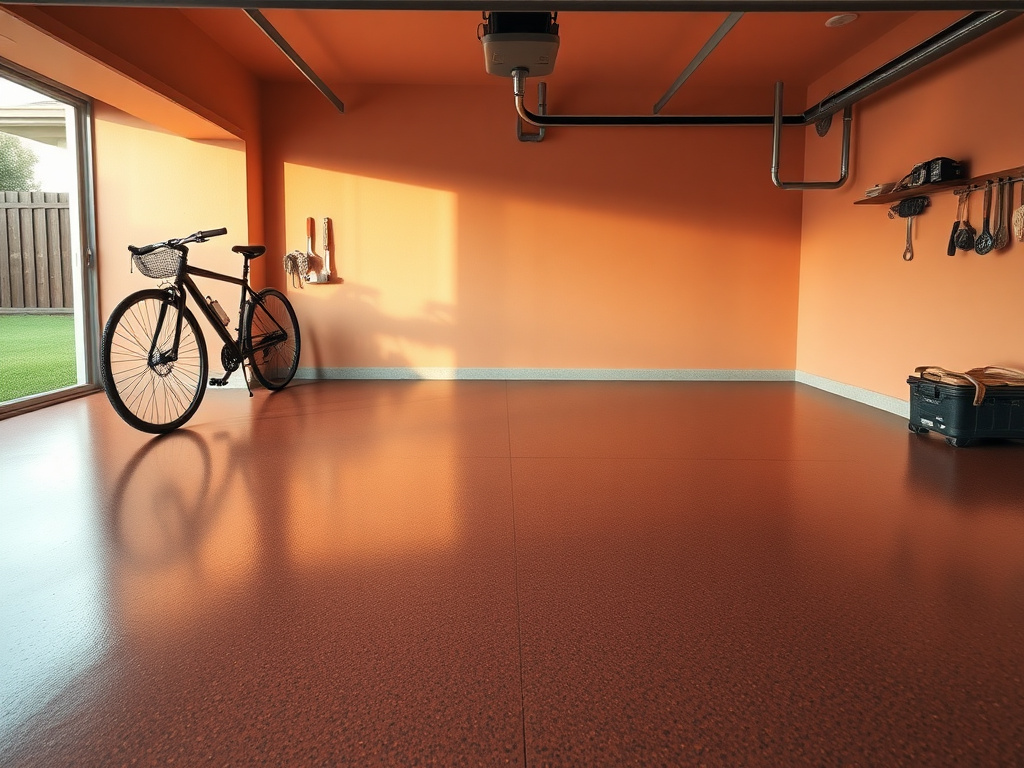
Residential & Commercial · One-Day Install
Polyurea Garage Floor Coatings in Florida — Installed in One Day
A fast-cure polyurea base coat, a full vinyl flake broadcast and a polyaspartic topcoat — ground in the morning, walked on that night, driven on the next day. Built for slabs that fight humidity, hot tires and salt air, not just dust.
1 Day
Grind to topcoat
20–30
Mils total dry film
24 Hr
Back on vehicle traffic
CSP 2–3
Ground surface profile
The failure pattern
Most garage floors we recoat in Florida did not fail from age — they failed from moisture
A Florida garage is not a conditioned room, and it sits on top of some of the highest water tables in the country. That combination pushes moisture vapor upward through the slab constantly, and a coating that was never designed for it traps that vapor at the bond line. The result is blistering, delamination and a milky haze under the film — problems homeowners in drier states rarely see and Florida garages see constantly.
Humidity attacks a second way, too. Porous, uncoated or thinly coated concrete holds onto surface moisture long after a storm passes, and that moisture feeds mildew and mold in the corners, along the door threshold and under stored boxes. Add a coating that was applied over a dusty, acid-etched surface instead of a real mechanical profile, and the film never seals that porosity in the first place.
Then there is heat. A Florida garage with a closed metal door in July still gets hot enough to bring tires in at well over 150°F after a highway drive. A coating with the wrong chemistry softens under that heat and grips the tire as it cools, and the next time the car pulls out it lifts a patch of coating with it — hot-tire pickup, and it is one of the two failures we tear out and replace most often.
The third factor is coastal. Garages within a few miles of salt water deal with airborne salt working into any hairline crack or pinhole in a coating, accelerating corrosion on stored tools, bike frames and equipment sitting directly on the floor. A sealed, seamless coating is one of the simplest ways to take that exposure off the table entirely.
Everything in the specification below exists to close one of those doors. If you want the underlying chemistry argument in full, read our polyurea vs epoxy comparison.
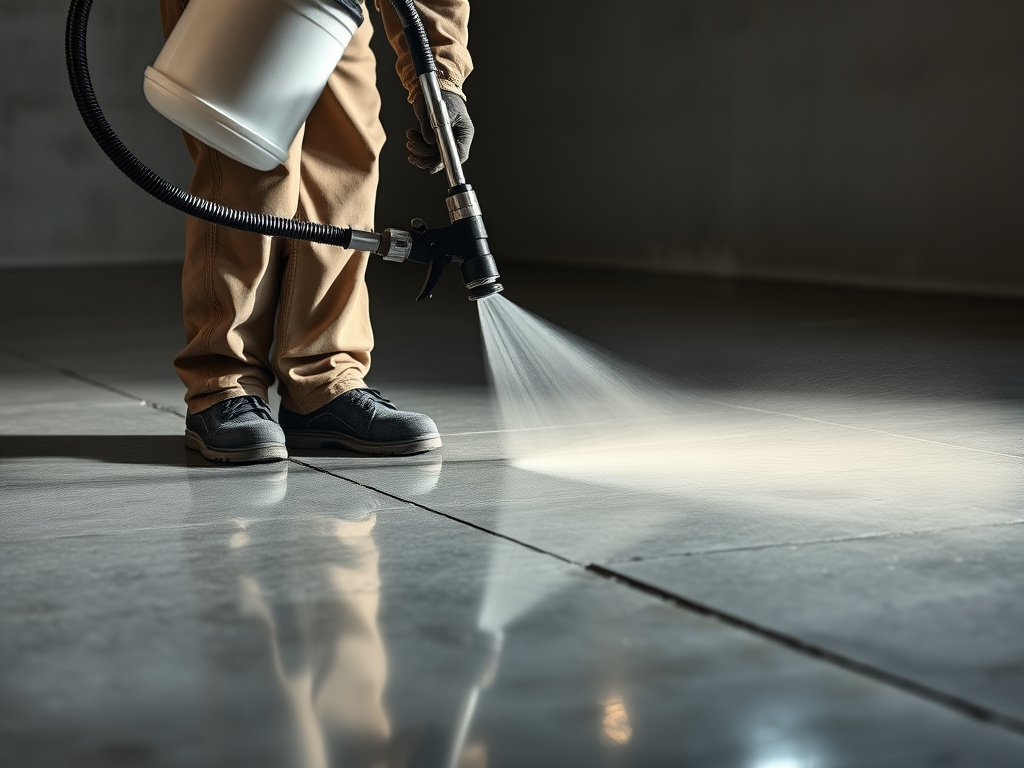
What full-broadcast flake actually buys you
Flake is not decoration. Broadcasting to refusal builds film thickness, hides slab irregularity, and puts a mechanical texture under the topcoat that a light scatter never delivers.
- ✓Adds meaningful mil build the resin alone cannot reach in one pass
- ✓Masks trowel marks, patch shadows and old saw cuts
- ✓Creates inherent traction before any additive goes in
- ✓Hides everyday dust and pollen between sweepings far better than a solid color
System specification
A base coat, a flake broadcast and a topcoat — each with one job
A garage floor system is not one product, it is a stack, and each layer does exactly one thing. The polyurea base coat is 100% solids and fast-cure, meaning it has no solvent to flash off and it reacts in seconds to minutes rather than hours. That chemistry wets the ground profile and drives resin into the capillaries the diamond tooling exposed — that penetration is where real adhesion lives.
The body coat is where vinyl flake gets broadcast to refusal, meaning the crew keeps throwing chip until the surface will not absorb another one. That is a real, observable endpoint, and it is the difference between a floor that reads as finished and one where you can see bare resin between the chips at a low sun angle.
The polyaspartic topcoat carries the whole burden of UV stability, gloss retention, chemical resistance and abrasion once the flake has kicked and been scraped flat. It is an aliphatic chemistry, which means it does not yellow or chalk out under Florida's sun the way an aromatic resin would within a couple of seasons.
On a slab that tests high for moisture vapor, we add a mitigation primer beneath the base coat rather than skipping straight to coating — the one extra step in the stack that Florida's water table makes worth the money almost everywhere in the state.
| System build | Polyurea base coat + full vinyl flake broadcast + polyaspartic topcoat |
|---|---|
| Total dry film thickness | 20–30 mils typical; heavier on shop and multi-bay slabs |
| Chemistry | 100% solids, fast-cure polyurea and polyaspartic resins — no solvent flash-off |
| Surface profile | Diamond-ground mechanical profile, not an acid etch |
| Moisture vapor tolerance | Tested per slab; mitigation primer available where readings run high |
| Return to service | Foot traffic same evening · vehicle traffic 24 hours · full cure ~72 hours |
| Slip resistance | Tunable from smooth gloss to an aggressive broadcast grade |
| UV stability | Aliphatic topcoat — holds color and gloss under direct sun through an open door |
Typical residential specification. Shop, multi-bay and workshop garages are spec'd heavier — ask for the written build sheet with your quote.
The one-day install
Five steps between an empty garage at 7 a.m. and a finished floor by evening
Three of the five steps happen before a coating pail is even opened. That ratio is the entire reason a properly installed polyurea floor outlives the slab it sits on.
7 AM — Clear & Test
Garage cleared, slab moisture-tested, cracks mapped, and an adhesion check run on any existing coating before a number is finalized.
8 AM — Diamond Grind
HEPA-shrouded planetary grinders open the slab to a mechanical profile. No acid etch, no chemical strip, no shortcut on a Florida slab.
10 AM — Chase & Rebuild
Saw-cut cracks, rebuilt spalls and the door threshold with polyurea patch material, then re-ground flush with the surrounding field.
12 PM — Base & Broadcast
Fast-cure polyurea base coat applied and immediately loaded with vinyl flake broadcast to refusal while the film is still open.
2–4 PM — Scrape & Topcoat
Standing flake scraped flat and vacuumed, then the polyaspartic topcoat goes down with your selected traction additive mixed in.
Prep is the product
Diamond grinding, crack repair and moisture testing — before any resin touches the slab
Nearly every recoat we do on a failed floor traces back to a shortcut taken in this stage, not a defective product.
- ✓Diamond grinding to open a real mechanical profile — no acid etch, no dusty laitance layer left behind
- ✓Crack chasing and structural fill on any active cracks before they can telegraph through the coating
- ✓Spall repair and threshold rebuild so the coating starts on sound, level concrete
- ✓Moisture vapor testing on every slab — critical given Florida's high water table and how often it goes unchecked
- ✓Mitigation primer applied where readings call for one, rather than coating over a wet slab and hoping
- ✓Full vacuum and tack-cloth pass immediately before the base coat goes down
Finish selection
Choose the finish for how you actually use the garage
Full-broadcast flake is the standard choice for daily-use garages — it hides dust, tire marks and the everyday wear of a working space better than any solid color. A partial or scatter flake gives a lighter, more open look at a lower material cost, and still masks minor slab imperfections.
Quartz broadcast steps up abrasion resistance for shop garages and workshops that see dropped tools and rolling toolboxes. Solid-color polyaspartic suits utility spaces where a clean, uniform look matters more than texture, and metallic systems are available for showroom and collector garages — though they need a clean, level slab and a realistic conversation about maintenance before anyone commits to one.
Every system takes a slip-resistance additive tuned to how wet the floor gets. A garage that sees rain-tracked tires and pool-wet feet coming in off the patio needs more grip underfoot than a dry, climate-controlled workshop.
Traction
A garage is not a pool deck and should not be finished like one
Traction is a dial, not a switch. We set it per space, and we set it before the topcoat is mixed rather than trying to fix it afterward.
- ✓Smooth gloss — clean showroom look for dry-only collector garages
- ✓Fine polymer bead — light traction with no change to gloss or cleanability
- ✓Standard aggregate blend — the everyday default for rain-tracked and pool-adjacent garages
- ✓Aggressive broadcast — ramps, sloped driveway aprons and wash bays
- ✓Integral cove base at the wall line where the floor gets hosed out regularly
- ✓Clean cut-in at the door threshold so the coating terminates flush, not feathered
If the same crew is coating your pool deck or patio, expect a different aggregate spec out there entirely — barefoot traffic and standing water change the target completely.
Why DIY kits fail first
Hot-tire pickup and humidity blush — the two problems polyurea was built to solve
Hot-tire pickup happens when a coating's chemistry softens under the heat a tire carries in off Florida asphalt — sometimes well over 150°F after a summer highway drive. A thin, single-coat epoxy kit softens at temperatures a properly formulated polyurea and polyaspartic system simply does not reach. Cool that softened patch back down under a parked tire and it grips, and the next time the car pulls away it peels a section of coating with it. That is a softening failure, not a bonding failure, and it is baked into the chemistry choice on day one.
Humidity blush is a related but separate problem — a hazy, milky discoloration that appears when a coating cures while moisture is present at the surface or trapped underneath it. Florida's dew point swings hard between morning and afternoon, and a DIY kit applied without checking either air conditions or slab moisture can blush, cloud or even fail to fully cure. A properly installed system accounts for slab temperature, humidity and moisture-vapor readings before the base coat ever goes down, which is exactly the step most weekend installs skip.
What moves the number
Square footage sets the floor. Slab condition sets the price.
Two similarly sized garages can price very differently, and the coating material cost is nearly identical in both. Prep is the variable — and in Florida, moisture is usually the biggest line item inside that variable.
Get an itemized quoteUsing typical Florida market ranges, a clean, dry two-car garage sits at the lower end of the pricing band. A three-car garage naturally costs more simply on square footage, and an oversized or workshop-length bay costs more still. None of those numbers move much on resin alone — resin is close to a commodity price across contractors.
What actually raises the number: how much crack chasing and spall rebuild the grind exposes, which nobody can price accurately from a photo; whether an existing coating has to be removed first and how easily it comes off; whether moisture-vapor testing sends the job to a mitigation primer; the flake, quartz or metallic system selected; and whether the scope includes cove base or an exposed driveway apron under full sun.
We quote prep as its own line rather than folding it into the total, because that is the line worth comparing between bids. Ask any contractor you're considering for their surface-profiling method, their target film thickness, whether they test for moisture before quoting, and what their warranty excludes. Four questions, and they sort the market fast.
DIY vs. professional
Why a big-box epoxy kit fails faster in a humid climate
A DIY kit is typically a thin, single-coat epoxy applied over an acid-etched surface, mixed and rolled in an afternoon with no moisture testing and no temperature or dew-point monitoring. In a dry climate that combination can look fine for a few years. In a Florida garage sitting on a high water table, it is working against three problems at once — vapor drive from below, humidity and dew point swings during the cure, and hot-tire exposure — that the kit was never engineered to handle.
A professional install differs at every one of those points: mechanical diamond-ground profile instead of an acid etch, a fast-cure polyurea and polyaspartic system instead of solvent-based epoxy, moisture-vapor testing before a drop of coating goes down, and application timed to slab and dew-point conditions rather than whatever Saturday happened to be free.
- ✓No moisture testing on a kit install — the single most common cause of early blistering here
- ✓Acid etch instead of mechanical profile — weak, inconsistent bond keyed
- ✓Thin single-coat film build with little tolerance for slab imperfections
- ✓No dew-point or slab-temperature monitoring during application
- ✓No professional warranty on workmanship or materials
- ✓Limited color, flake and traction options versus a full system menu
Living with it
Maintenance is a broom, a mop and a short list of things to avoid
A correctly installed polyurea garage floor should run many years before anyone talks about a refresh coat. Getting there is not complicated.
- ✓Dust mop or blow out weekly — grit tracked in from outside is the main everyday wear mechanism
- ✓Wet mop with a neutral-pH cleaner; skip harsh solvent or citrus-based degreasers
- ✓Wipe up storm debris, standing rainwater and yard chemicals reasonably promptly after they land
- ✓Avoid cheap recycled-rubber mats — their plasticizers migrate and can stain the film permanently
- ✓Choose polypropylene or vinyl-backed mats if you want floor protection under a workbench or tool cart
- ✓Do not pressure wash at close range with a narrow-angle tip at the door threshold edge
We install a written warranty on workmanship and materials with every garage floor project, and we cover every major Florida market statewide. If your slab is also sinking or settling, start with polyurethane concrete lifting before a coating goes down — a level slab is part of a good result.
What is the difference between polyurea and polyaspartic on a garage floor?
+
Polyaspartic is a type of polyurea — an aliphatic version built on an aspartic ester resin rather than a straight amine. That chemistry slows the reaction from a few seconds to a workable window a crew can squeegee and back-roll by hand. On most Florida garage jobs the two work as a pair: a fast-cure polyurea base coat penetrates and bonds to the ground slab, and the polyaspartic topcoat above it carries the UV stability, gloss and abrasion resistance.
How much does a polyurea garage floor cost in Florida?
+
Typical Florida market ranges run by size and prep. A two-car garage with a clean, dry slab lands at the lower end of the range; a three-car or oversized garage with crack repair, spall rebuild or a positive moisture-vapor reading runs higher. We give you an itemized, per-square-foot number after we grind and test the slab, not a phone-quote guess.
Will a polyurea garage floor lift when I park a hot truck on it?
+
Not when it is installed correctly. Hot-tire pickup happens when a coating softens under a tire that just came off hot Florida asphalt, then grips and peels as it cools. A properly bonded polyaspartic topcoat over a real diamond-ground profile does not soften at those temperatures the way a big-box epoxy kit does, so there is nothing for the tire to grab and lift.
Does Florida's humidity cause garage floor coatings to fail?
+
It is a factor, but the coating is usually not the root cause — moisture vapor moving up through the slab from Florida's high water table is. A tight, low-permeability film applied over a slab pushing vapor from underneath can blister or delaminate. We test moisture before we quote and use a mitigation primer when readings call for one, which is the step most DIY installs and low-bid crews skip entirely.
Is a DIY epoxy kit as good as a professional polyurea install?
+
No, and the gap shows up faster in Florida than almost anywhere else. Big-box kits are typically thin, single-coat epoxy applied over an acid-etched surface with no moisture testing. In a humid, high-water-table climate that combination tends to blister, peel or gray out within a couple of years. A ground, tested, multi-layer polyurea system is a different product entirely, not just a thicker version of the same one.
How long before I can park in my garage after coating?
+
Foot traffic that same evening, typically a few hours after the topcoat pass. Vehicle traffic at 24 hours, and full cure at roughly 72 hours. Florida's ambient humidity and temperature shift those numbers slightly by season, and we give you the actual return-to-service window for your install day before we leave the site.
Do rubber mats damage a polyurea garage floor?
+
Cheap recycled-rubber mats are the real risk — plasticizers migrate out of low-grade rubber and stain many resinous floors permanently where the mat sat, and trapped moisture underneath them can encourage mildew on Florida's humid slabs. A polypropylene or vinyl-backed mat is fine. The coating itself is built to be walked on, dripped on and hosed off.
Get a free garage floor quote
Send us the bay count, the slab age and a photo or two. We'll scope the prep on site and come back with an itemized, written number.