Storm Season Prep
Hurricane Season Prep: Protecting Garage, Patio & Pool Deck Floors from Storm Damage
Published · Florida Polyurea
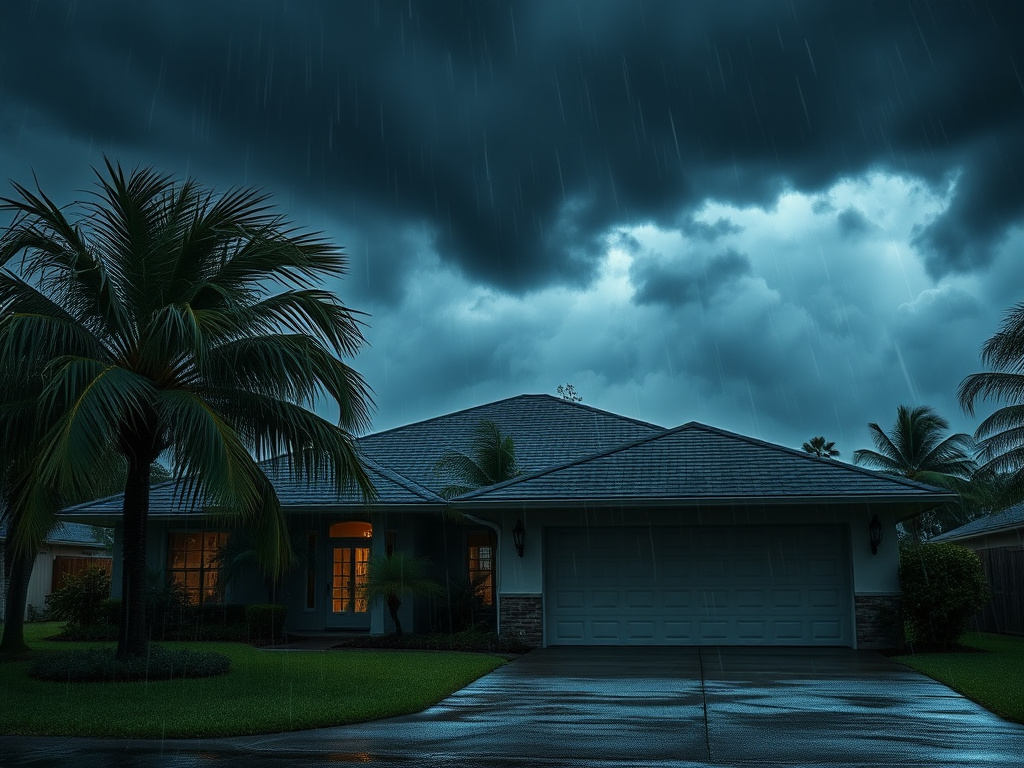
Florida hurricane season runs from June through November, and for most homeowners the storm prep list starts and ends with shutters, generators and flashlights. The concrete around the house rarely makes that list — right up until a garage floor is soft and chalky three weeks after a storm, or a pool deck that used to be a uniform tan is now blotchy, cracked and shedding chips of old paint underfoot. Concrete and the coatings on top of it take a real beating during a wet season, and the damage is physical and cumulative, not a one-time event tied to a single storm.
How Wind-Driven Rain and Flooding Damage Unprotected Concrete
Bare concrete is porous. Under normal rainfall it sheds most of the water it sees, but wind-driven rain during a tropical system doesn't behave like normal rainfall — it drives sideways under eaves, pools against thresholds, and saturates a slab from multiple directions at once instead of running off a single sloped surface. A porous, uncoated garage floor or patio slab soaks up that water, and once it's in the concrete, it doesn't leave quickly. Trapped moisture works on the slab from the inside: it feeds efflorescence (the chalky white mineral deposits that surface as water evaporates back out), and repeated wetting and drying cycles slowly break down the surface paste, leaving it soft, pitted and prone to spalling.
A slab with an older or already-failing coating is often worse off than bare concrete. Cracked, peeling or bubbled paint doesn't shed water — it traps it. Once wind-driven rain gets underneath a lifted edge of failing coating, that water has nowhere to evaporate from, and it sits against the concrete for days after the storm has passed. That trapped moisture is exactly what accelerates the coating's failure further, and it's also what pushes water toward the base material underneath the slab — the same base material that, if it saturates and shifts, is what leads to settlement months later.
Why a Seamless, Moisture-Tolerant Coating Outperforms Bare Concrete or Failing Paint
The reason a properly installed polyurea or polyaspartic system holds up through storm season comes down to two things bare concrete and old paint don't have: full adhesion and zero seams. A plural-component polyurea system is applied as a continuous membrane, chemically bonded to a mechanically prepped slab, with no lap lines or gaps for water to find its way underneath. There's no edge for wind-driven rain to lift, because there's no loose edge to begin with.
These systems are also built for the humidity Florida throws at an installation anyway. Polyaspartic topcoats cure fast and tolerate moisture-vapor drive from the slab far better than old-style epoxy, which is one reason a coated floor doesn't trap water against the concrete the way a failing epoxy or bare porous surface does. Add UV-stable pigments and flexible joint detailing that moves with the slab instead of cracking, and the floor is set up to shed a storm's rain rather than absorb it. That's the whole difference: a seamless coating manages water on top of the slab, while bare or failing concrete lets water get into it.
Post-Storm Inspection Checklist
After any named storm brings sustained wind-driven rain or standing water to your property, walk these four areas before assuming everything is fine. None of this requires special equipment — just a flashlight and a few minutes per area.
Garage floor
- ✓New soft, chalky or gritty patches where the surface used to feel solid
- ✓Fresh hairline cracks radiating from an expansion joint or the garage door threshold
- ✓White powdery residue (efflorescence) along the base of walls or at slab edges
- ✓Standing water or a damp smell that lingers more than a day or two after the rain stops
Patio
- ✓Coating that's bubbled, lifted at an edge, or peeling since before the storm
- ✓New pooling in a spot that used to drain, which can signal a settled low point
- ✓Cracks that widened or a control joint that opened up further than before
Pool deck
- ✓Slick or unusually rough patches where a slip-resistant texture used to be even
- ✓Discoloration or chalking around deck drains and coping edges
- ✓Any new gap or step between deck sections near the pool shell itself
Dock
- ✓Coating wear at the tide line or anywhere the surface took repeated wave action
- ✓Loose, soft or delaminating sections of decking near pilings
- ✓Fresh cracking or spalling on a seawall cap after wave surge or debris impact
When Settlement Shows Up After a Major Storm
Concrete floor damage is one problem; what's happening underneath the slab is a separate one, and a major storm can trigger both at once. Weeks of saturated soil under a driveway, garage floor or patio changes how that soil compacts, and Florida's sandy, karst-prone ground is already prone to settling once it's been through a heavy, sustained soaking. If a panel that was level before the storm is now visibly lower, if a crack has widened into a step you can catch a toe on, or if a slab has pulled away from an adjoining walkway, that's settlement — not a coating issue.
Settlement and coating damage often get diagnosed and repaired in the same visit, because you generally want a stable, correctly graded slab underneath before putting a new coating on top of it. If you're seeing new sinking or cracking after a storm, read through sinkhole and settlement concrete repair for how we diagnose it, and concrete lifting and slab leveling for how a no-demolition lift gets a sunken panel back to grade.
Scheduling Coating and Lifting Work Around Hurricane Season
The dry season, roughly November through May, is the easiest window to get new coating work done — humidity is lower, the slab dries and preps faster, and cure conditions are more predictable, which is why we recommend booking garage, patio and pool deck coating projects before storm season ramps up rather than during it. If you're heading into June with a floor you know is failing, get it scoped early; calendars fill up fast in the spring as more homeowners make the same call.
If damage happens mid-season, the process doesn't change much — we still start with an inspection to separate cosmetic wear from something that needs to be fixed before a new coating goes down, like an active leak, a settled panel, or base material that needs to dry out first. Coating installs can still happen between storms; we just plan the schedule around a realistic dry window rather than forcing an install ahead of weather that won't let it cure properly.
Prevention Beats Reacting to Storm Damage
This is about the physical condition of the concrete on your property and what keeps it from degrading storm after storm — not paperwork after the fact. A seamless, properly installed coating on a garage floor, pool deck, patio or dock is a maintenance decision that pays off every time wind-driven rain moves through, not just during the one storm that finally does visible damage. Pair that with an eye on drainage and grading around the slab, and most of what shows up on the post-storm checklist above simply doesn't happen in the first place.
Ready to get ahead of the next system? See what we do for garage floor coatings, pool deck and patio coatings, and marine, dock and seawall coatings, or start a free quote and we'll scope your property before the next named storm is on the map.
Should I coat my garage floor before hurricane season or wait until after?
+
Before, if the timeline allows it. Polyaspartic and polyurea coatings need a dry, prepped slab and a cure window with stable humidity, both of which are far easier to schedule in the dry season than in the middle of an active storm pattern. If a coating is already failing, closing it out before June gives it a full season to prove itself rather than starting a repair mid-storm.
Can a coating stop floodwater from getting into a garage or under a pool deck?
+
No coating stops standing floodwater from entering a space through a door threshold or low grade point — that's a drainage and elevation problem, not a coating problem. What a seamless coating does is keep the concrete itself from absorbing that water once it's there, so the slab doesn't spall, blister or trap moisture against the base once conditions dry back out.
What if my slab shifts or settles after a hurricane?
+
Heavy, prolonged rain saturates the soil under a slab, and saturated soil compacts and shifts more than dry soil. If a driveway, garage floor or patio panel is noticeably lower, cracked further, or pulling away from an adjoining panel after a major storm, that's a settlement issue to have inspected and lifted — not something a coating will fix on its own.