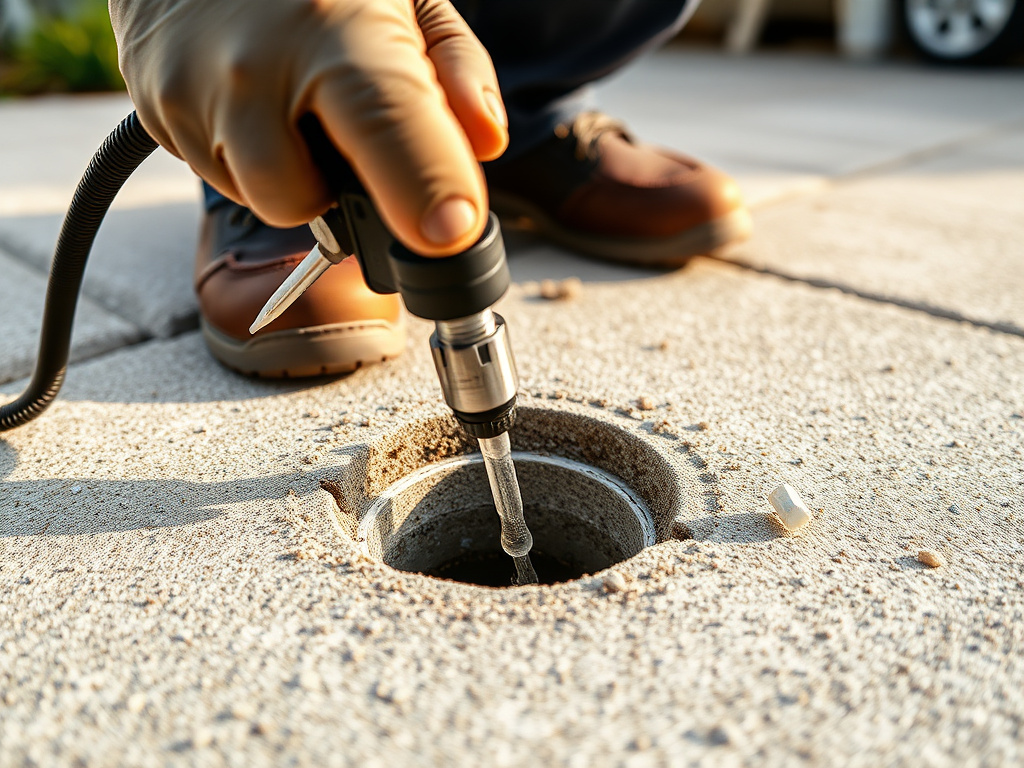
“How long will this last?” is the single most common question we get on a concrete lifting job, and it's a fair one — a sunken driveway or patio slab is rarely a one-time inconvenience if the ground underneath it is still moving. The straightforward answer is that the lift itself, done correctly, is durable. What varies is the soil it's sitting on, and in Florida, that soil does more to determine the outcome than almost anywhere else in the country.
What Actually Determines How Long a Lift Holds
Three things drive the lifespan of any concrete lift, and none of them is the lifting material by itself. The first is soil bearing capacity — whether the ground under the slab can support the load once the slab is back at grade. The second is drainage around and beneath the slab, since water is the single biggest driver of soil movement in either direction. The third, and often the most important, is the original cause of settlement: whether it was simple erosion, natural soil consolidation over time, or a deeper subsurface issue that a lift alone doesn't resolve.
A lift addresses the symptom — the slab is out of position — precisely and quickly. Whether that correction is permanent or temporary depends on whether the underlying cause was also addressed, which is why a competent contractor talks about drainage and soil, not just the injection itself.
Florida-Specific Factors: Water Table, Sandy Fill, Storm Saturation
Florida's ground behaves differently than soil in most of the country, and three statewide conditions show up on almost every job we scope. A high water table sits close to the surface across much of the state, which means the soil under a slab is frequently at or near saturation even without a storm event. Much of Florida's developed land also sits on sandy or engineered fill soil rather than dense native ground, and sandy fill compacts and shifts more readily under load and moisture cycling than denser soils do.
Then there's the seasonal pattern. Florida's wet season brings repeated heavy-rain saturation cycles that swell and then dry the soil under a slab, over and over, every year. That cycling is a normal part of living on Florida ground — but it's also exactly the kind of condition that can slowly reopen a settlement problem if drainage around the slab isn't managed.
On top of all of that, parts of the state carry an additional layer of risk from karst geology — the limestone bedrock formations responsible for Florida's “Sinkhole Alley,” the corridor running through Pasco, Hernando, Hillsborough, Polk, Marion and Alachua counties. In those counties specifically, ordinary soil settlement and sinkhole-related settlement can look similar at first, which is why an honest diagnosis matters before any repair is scoped. More on that distinction is on our sinkhole & settlement concrete repair page.
Polyurethane vs Mudjacking: Re-Settlement Risk
The lifting material itself matters more in Florida than it would in a drier, more stable climate, and the difference comes down to weight and water behavior. Traditional mudjacking uses a heavy cement-based slurry pumped beneath the slab. That slurry adds substantial new load directly onto soil that has already demonstrated it couldn't support the original load — which is exactly the wrong thing to add to sandy, saturated Florida ground. Over time, that added weight is a real contributor to re-settlement, especially in areas with a high water table.
Polyurethane foam works differently. It's a lightweight, closed-cell material that expands to fill voids and lift the slab while adding only a small fraction of the weight a cement slurry does. It's also moisture-resistant rather than moisture-absorbing, so it doesn't break down, wash out, or reabsorb water the way a cement-based fill can when Florida's water table rises during the wet season. That combination — less added load, no water degradation — is the core reason polyurethane lifting generally holds up better than mudjacking on Florida soil specifically, not just in general.
Maintenance and Monitoring Tips
A lift is not a set-it-and-forget-it repair, and a small amount of ongoing attention goes a long way toward keeping it in place. The goal in every case is managing water around the slab, since water is the common thread behind nearly every recurring settlement issue we see.
- ✓Keep gutters and downspouts discharging well past the slab edge, not directly onto it
- ✓Redirect sprinkler heads that spray onto driveway, patio or foundation edges
- ✓Re-grade any soil that slopes toward the slab so water sheds away from it instead
- ✓Re-caulk expansion and control joints after a lift so runoff can't keep washing out the base material
- ✓Walk the property after major storms and note any new cracking, gaps or low spots
- ✓Track the date and location of any lift so a pattern of repeat settlement in the same spot is easy to spot
When a Second Lift Is Normal vs a Sign of Something Bigger
A second, smaller lift years after the first — particularly following an especially wet season, or before a drainage issue gets fully corrected — is a routine maintenance event, not a sign that the original repair failed. Ground settles gradually over years in most of Florida, and a minor touch-up on one panel or a small section of driveway is a normal part of owning a slab on Florida soil.
What's not normal is fast, repeated settlement in the same location within months, or settlement that keeps expanding beyond the original repaired area. Other signs worth taking seriously include cracking that extends into an adjoining wall or foundation, doors and windows that start sticking, or a depression in the yard that keeps growing rather than stabilizing. That pattern — especially inside the Sinkhole Alley counties — points to an unresolved subsurface issue rather than ordinary settlement, and it warrants a dedicated inspection rather than another routine lift. Our sinkhole & settlement concrete repair page covers how that diagnosis and repair process works.
Cost Over Time: Lifting vs a Full Repour
Treat the figures below as typical Florida market ranges, not a quote for your specific slab — actual pricing depends on square footage, how much lift is needed, and access to the job site.
$5–$25
Per sq ft, polyurethane lift
$3–$8
Per sq ft, mudjacking
$1.7K–$4K
Typical whole-project range
~1 Day
Typical return to use
The cost case for lifting over a full repour is straightforward. Polyurethane injection generally runs about $5 to $25 per square foot depending on scope, compared to roughly $3 to $8 per square foot for traditional mudjacking, and a typical whole-driveway or patio-scale project usually lands in the $1,700 to $4,000 range. A full repour costs substantially more once demolition, disposal and new concrete are factored in, takes far longer to complete and cure, and still doesn't guarantee the underlying soil issue is resolved — a repour poured onto the same unaddressed soil condition can settle again just as the original slab did.
Lifting also preserves the existing slab's finish, color and age, which matters for driveways and patios where a patched-in section of brand-new concrete would otherwise stand out against older, weathered concrete around it. For a full breakdown of when each approach makes sense, see our concrete lifting vs. slab replacement comparison, or read more on how the lifting process itself works on our concrete lifting & slab leveling page.
The Bottom Line
A polyurethane lift is a durable, permanent-grade correction when the soil and drainage conditions around it are properly managed. In Florida, that means accounting for a high water table, sandy fill soil and seasonal storm saturation from the start — which is exactly why a real scope, not a phone-quoted number, is what determines whether your lift is a once-and-done repair or the first of several.
Common questions
Concrete lifting longevity: quick answers
Does a polyurethane lift last as long as new concrete?
+
A lift restores the existing slab to grade — it doesn't replace the concrete itself. How long that correction holds depends far more on the soil underneath and what originally caused the settlement than on the age of the slab. On stable, well-drained soil, a properly scoped lift can hold for many years; on soil with an unresolved water or erosion problem, any repair — lift or repour — is working against the same underlying issue.
Is it normal to need a second lift eventually?
+
A minor touch-up years later, especially after a major storm season or before an irrigation issue is corrected, isn't unusual and doesn't mean the first lift failed. What's not normal is rapid, repeated settlement of the same area within months — that pattern points to an unresolved cause rather than an expected maintenance cycle.
Why does polyurethane hold up better than mudjacking in Florida specifically?
+
Mudjacking uses a heavy, cement-based slurry that adds substantial new weight onto soil that has already shown it can't support the existing load. Florida's sandy, high-water-table soil is particularly prone to re-settling under that added weight. Polyurethane foam weighs a small fraction as much, distributes load more evenly, and doesn't break down or reabsorb water the way a cement slurry can over time.
How do I know if my settlement is a Sinkhole Alley issue rather than ordinary soil settlement?
+
Ordinary settlement is usually isolated to one slab or panel and stays put once corrected. Signs pointing to a larger karst or sinkhole-related issue include settlement that keeps expanding beyond the original area, cracking that extends into adjoining structures or walls, doors and windows sticking, or a depression that keeps growing in the yard. If you're seeing any of that, it's worth a dedicated inspection rather than a routine lift.